CLASSICAL

Ferdinand Ries
Clarinet Trio & Sonatas
Vlad Weverbergh; Jadranka Gasparovic; Vasily Ilisavsky
Brilliant Classics (dist. Naxos)
BRI 96903
Ferdinand Ries
Flute Quartets Vol. 3
Ardinghello Ensemble
CPO (dist. Naxos)
555378-2
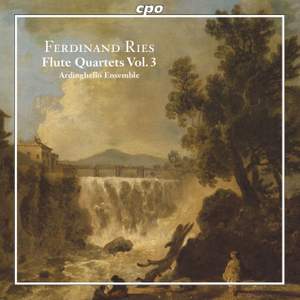
Famously associated with Beethoven (as both student and secretary), Ferdinand Ries spent a rather tumultuous career shuttling unwillingly between Bonn, Vienna, Frankfurt, and London, tossed back and forth by the vicissitudes of war and politics. Despite all the disruption, he managed to produce a prodigious catalog of both chamber and large-scale works including three operas and two oratorios. These two recordings focus on his chamber music. The Brilliant Classics disc looks like a reissue (the recordings were made in 2006), but I can find no evidence that it’s been released prior to this, so library collections are not likely to hold an earlier version. Clarinetist Vlad Weverbergh delivers heartfelt performances of two sonatas and a trio with piano and cello (on modern instruments), demonstrating clearly both Ries’ stylistic debt to his mentor and his own ability to take that influence and expand on it in deeply personal ways. The third volume in the Ardinghello Ensemble’s series of recordings of Reis’ flute quartets has a bit of a different flavor, mainly due to the different tonal character of the flute — but also to the somewhat more high-classical style of the melodies. While no background information about this recording was provided with the review e-copy, from what I can determine it appears that the Ardinghellos’ string players use modern violins, while flutist Karl Kaiser (a veteran member of the Camerata Köln) plays a period flute; that combination yields a lovely blend of depth and lightness to their sound.
Alvin Lucier
One Arm Bandits
Important
IMPREC514
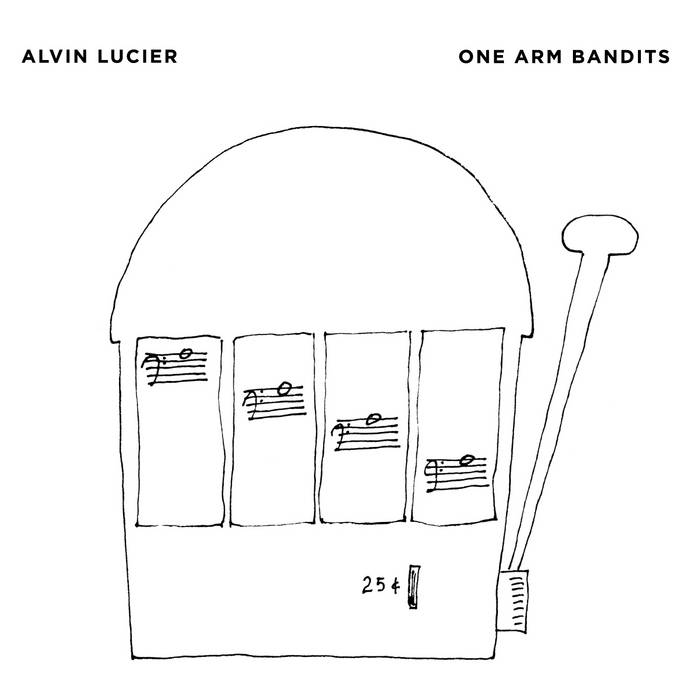
It would be a mistake to regard Alvin Lucier’s compositions as examples of “conceptual music.” While they are often built on a particular musical concept, the concept itself is always about the nature of sound and pitch. (For example, his most famous work, I Am Sitting in a Room, is based on the concept of reverberation, and examines the cumulative effect of ambient reverberation on multiple generations of a single recording.) With One Arm Bandits, Lucier is exploring the limits of unison in the context of the cello. In each section of the piece (one section for each string on the cello), four cellists play the same open string for about 15 minutes, following instructions that tell them how much pressure to apply to the string at different points in the performance. Variations in bow pressure yield microtonal variations in pitch and even subtler variations in timbre. The changes are hard to detect, of course, which is part of the point: in order to appreciate what Lucier is doing, you need to listen really hard. This piece takes the concept of “minimal music” to a new level.

Henry Purcell
Fantazias
John Holloway Ensemble
ECM
2249
Casual classical-music listeners might be surprised to know the degree to which improvisation plays a role in baroque music. It’s particularly important in the context of the fantasia (a.k.a phantasy, fantazia, fancy, fantasy, etc.), a musical form that requires players not only to improvise according to a predetermined musical idea, but often to do so in counterpoint. The fantasias of Henry Purcell carried on the tradition of English fantasia composing that had been inaugurated earlier in the 17th century by William Byrd, John Coperario and, especially, William Lawes. For this recording of Purcell’s three- and four-part fantasias, the John Holloway Ensemble uses one violin, two violas, and a cello, creating a somewhat different sound from that of the viols that one usually hears performing this repertoire. The playing is excellent, and this recording should be of interest to any library supporting instruction in baroque music. (For pedagogical purposes, I’d recommend including it in the collection alongside Hesperion XX’s account on seven viols.)

Francisco Guerrero
Ecce sacerdos magnus
The Brabant Ensemble / Stephen Rice
Hyperion (dist. Integral)
CDA68404
Yup, it’s another recording from the Brabant Ensemble — and another thoroughly predictable recommendation from me. Of all the Oxbridge groups, I think the Brabants are at the top of the pile when it comes to intonation, tone, and pure creamy richness of sound. (Stile Antico are right up there too — and perhaps not coincidentally, the two groups share several members.) The group’s latest recording centers on the Missa Ecce sacerdotus magnus (“Behold, the great priest”) of Francisco Guerrero — one of the three greatest composers of the Spanish Renaissance, though not one of the most recorded. Not only is this disc a magnificently beautiful listening experience, it is also the world-premiere recording of both the Mass and the eight motets and one Magnificat setting that accompany it. No library with a collecting interest in early music can afford to pass this one up.

Arvo Pärt
Odes of Repentance
Cappella Romana / Alexander Lingas
Cappella (dist. Naxos)
CR428
What is presented here as the Odes of Repentance is a program of choral works by Arvo Pärt that are selected and arranged as a “service (or office) of supplication.” Selections from Triodion, Kanon Pokajanen, Zwei slawische Psalmen, and The Woman with the Alabaster Box are arranged to follow the order of an Orthodox Service of Supplication, in which the congregation expresses penitence and celebrates forgiveness and reconciliation. Cappella Romana’s usual focus on medieval (and earlier) music has been a good preparation for performing the works of this beloved contemporary composer; Pärt’s spare, sometimes almost severe style draws explicitly on elements of medieval sacred music, and on the Orthodox rite in particular. This recording was made in a space that frames Cappella Romana’s voices perfectly for this music: the acoustic is open and spacious but oddly dry at the same time.

Carl Philipp Emanuel Bach
The Württemberg Sonatas (2 discs)
Keith Jarrett
ECM
2790/91
Though made in 1994, Keith Jarrett’s recording on modern piano of C.P.E. Bach’s six “Württemberg” keyboard sonatas is now being released for the first time, almost 20 years later. The pieces were written for Bach’s student the Duke of Württemberg in 1742 and 1743, and mark an important stylistic transition point between the baroque and classical styles. When played on the harpsichord (as they almost invariably are), they of course sound more or less baroque — but the combination of the darker and more flexible sound of the modern piano and Jarrett’s own personal playing style bring out the incipient classicism of these lovely pieces. To be clear, Jarrett’s performances are perfectly idiomatic, and he’s obviously being careful not to bring an alien pianism to the music — but you can tell it’s Jarrett, in all the best ways. Among other things, his sense of line and sensitivity to the interaction of contrapuntal voices are everywhere apparent, and the album is a pure delight.
JAZZ

Adam Birnbaum
Preludes
Chelsea Music Festival
No cat. no.
Although I fully recognize that jazz-classical fusion is a field filled with musical landmines, through which only a few select talents are able to make their way without disaster, the music of J. S. Bach offers a relatively safe path. In my view, there are two reasons for this. The first is Bach’s unparalleled (among the baroque masters) gift for melody; the second is that his rhythms are generally so square and solid that you can swing them with powerful effect. Among those who have successfully adapted Bach’s music to the jazz idiom, pianist Adam Birnbaum is on the top tier. This collection of trio arrangements draws on the first half of Bach’s Well-tempered Clavier, pulling out twelve preludes while leaving the fugues alone. Unlike some other jazz players who have made similar forays into Bach’s keyboard music, Birnbaum isn’t content just to set the music to a swing beat; his arrangements are complex and varied, and bring a whole new dimension of musicality to the original melodies. (Note, in particular, the Latin setting of the E minor prelude.) For all libraries supporting keyboard and/or jazz pedagogy.

Madd for Tadd
Central Swing & Our Delight (2 discs)
Self-released
No cat. no.
This is really two albums in a single package: the first disc consists of charts that celebrated composer Tadd Dameron wrote in 1940 for the Kansas band Harlan Leonard and His Rockets (with the addition of a 1949 tune, the ballad “Heaven’s Doors Are Open Wide”); the second disc is a program of other Dameron tunes from the 1940s, many of which became favorites of bebop players like John Coltrane and Blue Mitchell. In fact, it’s as a composer for small bop ensembles that Dameron gained his greatest fame, and I bet you didn’t know that he wrote “Soultrane” and “Mating Call,” did you? (OK, maybe you did, but I didn’t.) This project reflects a decades-long interest in Dameron’s music on bandleader Kent Engelhardt’s part; many of these arrangements are his own transcriptions from old recordings. The playing by the whole band is superb, but those arrangements are the real star here. Strongly recommended to all jazz collections.

Natraj
Ragamala Paintings Alive! (digital only)
Big Round (dist. Parma)
BR8983
I had to listen to this one before I could decide whether it belonged in Jazz or World/Ethnic. Natraj is a quintet led by soprano saxophonist Phil Scarff, that also includes violinist Rohan Gregory, bassist Mike Rivard, drummer Bertram Lehmann, and percussionist Jerry Leake. (Vocalist Jayshree Bala Rajamani makes a guest appearance as well.) The music is billed as “contemporary jazz with influences from India and Africa,” and that’s just what it is: not really Indo-jazz fusion, but modern jazz that draws on raga melodies and African rhythms and explores them in a jazz style. The album is programmatically organized around a multimedia work centered on ragamala paintings, miniature artworks that were created in India several hundred years ago to illustrate the nature of various ragas. The liner notes provide a helpful guide to the paintings that helps put the music in context. This is a thoroughly enjoyable and completely unique jazz recording.

Anakronos
Citadel of Song: Ballate from Boccaccio’s Decameron (2 discs)
Heresy (dist. Redeye)
028
And while we’re at it, let’s also talk about a new album that offers a fusion of jazz and medieval European music. The ten songs on this album from the delightfully odd Anakronos ensemble are taken from Giovanni Boccaccio’s Decameron, a 14th-century song cycle that depicts the vicissitudes of romantic love in the context of the fear and anxiety that gripped Europe during the Black Plague. Led by singer/composer Caitríona O’Leary, the ensemble arranges these tunes for electric guitar, percussion, saxophones, clarinets, and voice, weaving beautiful and sometimes trance-inducing tapestries of melody and subtle rhythm; there were moments when I would have sworn the clarinet was a Persian ney; there are moments when the saxophone and guitar lock together to create what sounds like Middle eastern bebop. No label other than Heresy is doing anything remotely like this, and I recommend their whole catalog to all adventurous library collections.

Art Hirahara
Echo Canyon
Posi-Tone
PR8250
One of the great things about the Posi-Tone label is the presence of pianist/composer Art Hirahara on so many of its releases — and when he steps out as a leader, it’s even more exciting. His latest is a gorgeous and impressionistic program of new material as well as tunes that he and bassist Boris Koslov had written for earlier projects, most of them substantially reworked. Hirahara’s style harks back to the glory days of Bill Evans: big, juicy chords and nimble rhythmic shifts through which sweet and intelligent melodies make their sinuous way. New material includes a hymn-like tribute to Tyre Nichols, a young Black man killed by police earlier this year, and a complex bebop tune that Hirahara wrote for Koslov titled “The More Things Change.” Throughout the program, drummer Rudy Royston provides his typical subtle and tasteful rhythmic underpinnings. Brilliant.
FOLK/COUNTRY

Kristen Grainger & True North
Fear of Falling Stars
Self-released
No cat. no.
Traditional bluegrass music is typified by fast, hard-edged, virtuosic picking and intense singing. It’s always been a very male genre — no matter how high the voices, the sound has usually been aggressively macho. Unsurprisingly, in recent decades new voices and new sounds have emerged in response, and a growing number of them have been women’s voices singing in a very different style. While the music made by Kristen Grainger and her band True North is not exactly bluegrass, it’s closely bluegrass-adjacent — but it’s also different in very significant ways. Grainger’s voice is clear but gentle; her bandmates contribute harmonies that are tight but silky. The songs draw on bluegrass tradition (note in particular the high-lonesome harmonies on “Memories and Moments”) but take its elements in entirely new directions without ever seeming aggressively experimental. Highly recommended.

Piskey Led
Piskey Led (digital only)
Self-released
No cat. no.
For most people, the term “Celtic music” means Irish (and maybe also Scottish) tunes and songs. But the Celts, and their musical traditions, are distributed much more broadly than that: Celtic music is found in Wales, Cornwall, western France, and (oddly) even northwestern Spain. Piskey Led is a Cardiff-based band that specializes in tunes from Cornwall, Ireland, and northern England, reflecting the bandmembers’ own regional origins. Songs and tunes are a variety of original compositions and traditional numbers gathered from 19th-century tune- and songbooks, including disaster ballads, an ode to a long-defunct train line, and celebrations of traditional industries like mining and fishing. The playing is pretty straight-ahead, though the group’s arrangement of “Ashton Famine” reminded me, startlingly, more than a little of Henry Cow. Great playing and great singing all around, and a repertoire that will probably be underrepresented in most library collections.

Tim Easton
Special 20 (reissue)
Black Mesa
BMR072-02
This was the second album made in Nashville by the then-recent transplant Tim Easton. It was 1998, and working with producers Brad Jones and Robin Eaton at Alex the Great Recording, he made a record that drew on outlaw country, greasy roots rock, and singer-songwriter folk – but with an emphasis on “outlaw.” His voice is plainspoken and declamatory; the guitars are ragged and rich with distortion; the tempos are, for the most part, syrupy slow. “Help Me Find My Space Girl” nods obliquely to Byrds-era jangle pop, and “Sweet Violet” is a gentle ballad complete with psychedelic flourishes in the chorus, but for the most part these songs are serrated and aggro, in all the best ways. Recommended to all libraries. (Black Mesa is simultaneously releasing a second Tim Easton album from the same period, titled Not Cool.)
ROCK/POP

Jon Hassell
Further Fictions (reissue; 2 discs)
Ndeya (dist. Redeye)
NDEYA10CD
In 1990, experimental trumpeter Jon Hassell released City: Works of Fiction, on which he continued his exploration of the “fourth world” sound he had pioneered during the previous decade, incorporating rhythmic elements from Africa and the South Pacific along with eerily harmonized processed trumpet melodies and funky basslines. A three-disc expanded reissue was released in 2014 on the All Saints label, adding a second disc that documented his live band’s work leading up to that release, and a third that radically remixed and reconceptualized the material from the album. That reissue is now long out of print, and this two-disc set brings much (though sadly and inexplicably not all) of the music from the second and third discs back to market in a lovely hardbound book package. If your library already owns the original expanded edition there’s no need to grab this version – but if not, this reissue is a great opportunity to bring on board some of the most oddly lovely music of Hassell’s long career.

Rooney
Rooney (reissue; vinyl & digital only)
Real Gone Music
RGM-1591
In 2003, Rooney released their first of three albums, which went on to sell half a million copies and has been reissued about a hundred times – but never, until now, on vinyl. (Sadly it’s out of print on CD, but used copies are easy to find.) This album made enough of an impression on Johnny Ramone that he invited the band to contribute to the Ramones tribute album We’re a Happy Family. Twenty years later, the music still stands up well, and doesn’t even really sound dated: the stroppy guitars and handclaps on “Blueside,” the smirking romantic self-laceration and fruity chord progression on “I’m a Terrible Person,” the anthemic “Daisy Duke” – all of this stuff is pretty much timeless, and the hooks never stop. And now if you want it in vinyl, here it is.

VEiiLA
Sentimental Craving for Beauty
Projekt (dist. MVD)
413
“Disguised as relaxing downtempo music, VEiiLA leans towards Schopenhauerien pessimism where one does not conquer the pain; verily submission to pain is the only answer to a world that is made of suffering.” Okay! This is probably the first time I’ve typed the phrase “Schopenhauerian pessimism” into a CD HotList review, but that’s not necessarily a bad thing. And the press materials do not mislead: the music of VeiiLA draws on the Russian duo’s experience as exiles from a country they can no longer support. More from the press materials: “As modern Russian dissidents they taste the bitter liquor of disappointment blended with a healthy dose of morbid, soul-crushing realization: the world is in fact as ugly as it gets.” Fortunately for you, the listener, this realization results in some genuinely compelling dark and downtempo electro-pop music with hints of trip hop, jungle, and techno weaving through the mix. Imagine a more Slavic Dead Can Dance, or a more depressed and ‘luded-out early Ministry, with much better vocals. That’s a compliment, I promise.

Palm Skin Productions
A Swarm in July (digital only)
Tru Thoughts (dist. Redeye)
TRU447D
A Swarm in July by Simon Richmond (a.k.a. Palm Skin Productions) is billed as a “concept record,” but to be honest it’s not 100% clear what the concept is. The press materials offer lots of resonant phraseology, but not much conceptual coherence: “A proverb. A phrase. A saying. A Say-ing – the performances of that which has been said. A maxim. A truism. True-ism – the ideology or the myth of truth? Whose truth?…” — you get the idea. But that’s okay, because the music is compelling, from the bustling post-bass of “We Stand Divided” through the unsettled ambience of “Himself and the Devil” right through “The Sword Will Die” with its market-stall cowbells and jazzy piano chords and “I Say Not As I” with its spoken-word samples of playwright Harold Pinter and its elephantine beat. The album closes with a touching tribute to Richmond’s recently deceased father titled “Far from the Tree,” a sort of broken-beat meditation that is both funky and gentle. Recommended.

Pere Ubu
Elitism for the People 1975-1978 (reissue; 4 discs)
Fire
FIRECD406
Pere Ubu’s early catalog has been reissued multiple times over the decades since the band burst on the scene in the mid-1970’s defining a template for art-punk that would be adopted and adapted by others for years to come. Most of those earlier reissues are now long out of print; the latest iteration is a pair of handsome book-bound four-disc sets from the Fire Records label. The first, Elitism for the People, includes The Modern Dance and Dub Housing (Ubu’s first two albums) along with a disc of single releases fans will recognize as forming the core of the Terminal Tower collection, along with an extract from a cassette recording of a 1977 gig at Max’s Kansas City (oddly, the disc includes only six songs from that recording; the full version is available digitally at Ubu’s Bandcamp page). This music is essential; if your library doesn’t already hold these albums, take advantage of this fine new issue. (Equally essential is Architecture of Language, a similarly-configured set that includes The Art of Walking, New Picnic Time, and Song of the Bailing Man along with various rarities and outtakes.)
WORLD/ETHNIC

Lee “Scratch” Perry
Destiny (digital & vinyl only)
Delicious Vinyl/Island
No cat. no.
Discerning reggae fans have learned to be leery of Lee “Scratch” Perry albums from late in his career: too many have been musically underwhelming collaborations that reeked of opportunism, chances for young producers to hitch a ride on Perry’s spaceship for their own purposes rather than engage in genuine musical collaboration. But there have been encouraging exceptions, and this project with producer Bob Riddim, completed during the last year of Perry’s life, is one such. The backing tracks are deep and heavy and strike a lovely balance between the old-school verities and a forward-looking production style. Perry’s vocal contributions mine his usual topics with his usual inscrutable sincerity, and guest vocalists like Kabaka Pyramid and Evie Pukupoo bring an added layer of lyricism and melodic interest. This is the most satisfying Lee Perry album since his collaborations with Adrian Sherwood.

Bards of Skaði
Glysisvallur: Musick from the frozen Atlantis
Nordvis Produktion
No cat. no.

Fränder
Fränder II
Nordic Notes
No cat. no.
Here are two very different examples of heavy Nordic music. Though their album cover might lead you to expect some kind of metal, Bards of Skaði actually work in an orchestral, sometimes cinematic style. The sonic spaces are huge, with far-off whistles, warm strings, and fingerpicked guitars creating an evocative soundscape that will have you dreaming of fjords and green mountains and mythic warriors. Bards of Skaði’s music is heavy the way trees are heavy and fields are redolent after a rainstorm. Fränder does something quite different: their approach could be described as “heavy folk.” The instruments are acoustic, the tunes and songs are original but very traditional-sounding — however, their style is rockish, with anthemic choruses and aggressive drums. Tight harmonies and giddy dance rhythms add an element of nimbleness to the heavyosity, creating a completely unique musical experience.

Creation Rebel
Hostile Environment
On-U Sound
ONUCD160
It’s been 40 years since we last heard from the mighty Creation Rebel, charter members of the On-U Sound recording stable and, alongside label head and producer Adrian Sherwood, key architects of that label’s unique sound. The band’s core is guitarist “Crucial” Tony, drummer Charlie “Eskimo” Fox, and percussionist Mr. Magoo, but on this new album they’re joined by a panoply of guests including legendary speed-rapper Daddy Freddy, neo-dub producer Gaudi, and saxophonist Dean Fraser. Their sound is as rich and dark and dubwise as ever, and as an added bonus they’ve dug up some archival recordings of the late Prince Far I, who appears posthumously on two tracks. This is a hugely welcome return from one of the UK’s finest roots reggae ensembles.

 CD HotList
Re: Rooney. “In 2003, Rooney released their first and only album…” Wikipedia and Qobuz show three albums with the original quintet: Rooney 2003, Calling The World 2007 and Eureka 2010.
Right you are — thanks for the correction. I’ve edited the review accordingly.