CLASSICAL
Julius Eastman
Femenine
Talea Ensemble; Harlem Chamber Players
Kairos (dist. MVD)
0015116KAI
Written in 1974, when Julius Eastman was on the music faculty of SUNY Buffalo and performing as a founding member of the S.E.M. Ensemble, Femenine is a fascinating long-form work that blends strict composition with improvisation, and draws heavily on first-generation minimalist technique while also defining a unique style of its own. It’s also part of a cluster of early-1970s pieces in which he dealt explicitly with issues of Black and queer identity, challenging currently-received assumptions about both. With Femenine, however, the explicit challenge is limited to the work’s title; the music itself carries no obvious sociopolitical content. As realized in this arrangement by the Talea Ensemble and the Harlem Chamber Players, the work is reminiscent of compositions by Steve Reich in its highly limited harmonic development and its dense elaboration of a single melodic motif through textural and rhythmic variation, but Eastman’s unique musical personality ensures that this would never be mistaken for a Reich piece. The performance and the recorded sound are both brilliant.

William Byrd
Sacred Works (2 discs)
The Saint Thomas Choir of Men and Boys / Jeremy Filsell; Gerre Hancock
Signum Classics (dist. Naxos)
SIGCD776
One of the first things that will strike you about this very fine (and generous) selection of sacred choral music by the great English composer William Byrd will be the production style: the choir is recorded in a large church space, and the sound is resoundingly, unapologetically churchy: the listener hears the whole space, and gets a sense of distance from the choir — without any appreciable loss of detail. The program itself is also remarkable: it consists of a reconstructed Catholic Mass for the feast of Corpus Christi alongside a 1981 recording of an earlier version of this choir performing Byrd’s Anglican Great Service — illustrating the political reality that shaped and constrained Byrd’s compositional output throughout his career as both a devout Roman Catholic and a court composer to the the head of the Church of England. The music, of course, is consistently glorious — Byrd is one of two or three obvious candidate’s for the title of England’s Greatest Composer — and so is the singing. This is a magnificent release all around and should find a home in any library with a collecting interest in Renaissance music.
Various Composers
The Golden Hour
Lucile Boulanger; Simon Pierre; Olivier Fortin
Alpha Classics (dist. Naxos)
ALPHA 1059
This program of six French trio sonatas from the Regency period showcases the works of composers most readers will recognize (Jean-Marie Leclair, Joseph Boudin de Boismortier) as well as some by a couple of less familiar, though by no means obscure, names (Louis-Antoine Dornel, François Francoeur). The unifying theme of this album is the documentation of a highly important moment in the development of French music, with the viola da gamba in decline, the violin growing in popularity, and the resolution (after a long period of conflict) between purist French style and the increasingly beloved Italian approach. Some of these were originally written for two violins and continuo, but are arranged here for violin, viol, and harpsichord; one was originally intended for solo violin. All of the works represented are examples of an approach that would come to be called “les goûts réunis,” a phrase coined by François Couperin to signify a reconciliation of the conflict between different national styles of composition. This is both a lovely and an instructive recording.
Jürg Frey
Continuité, fragilité, résonance
Quatuor Bozzini; Konus Quartett
elsewhere
026
Jürg Frey
Les Signes passagers
Keiko Shichijo
elsewhere
029
The chamber music of Jürg Frey is both quiet and unsettling. Describing his long one-movement work, the aptly titled Continuité, fragilité, résonance, Frey writes: “the new piece will work with sound movements and stillness, but always develop these phenomena out of silence and lead them back into silence, thus creating its own acoustic reality of concentration and deepening.” One could argue that all musical phenomena develop “out of silence,” but in the case of Frey’s music this is psychologically as well as literally true. This piece in particular, written for an octet consisting of string and saxophone quartets, begins with near-silence and gradually swells to a sort of high mezzopiano, with extended instrumental lines layering and overlapping each other to create chords that are sometimes gently sad and that occasionally bristle with a quiet foreboding. Les Signes passagers, on the other hand, is written for solo fortepiano and consists of seven relatively brief movements. This music is very quiet as well, but here Frey is exploring the sonic world of an instrument known for its limited dynamic and timbral palette; instead of pushing its boundaries, he keeps things low-key — but there’s plenty of complexity in the delicacy of his compositions.
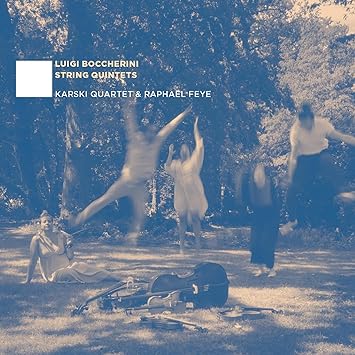
Luigi Boccherini
String Quintets
Karski Quartet; Raphaël Feye
Evil Penguin
EPRC0057
Writing in 1784, the great music historian Charles Burney said of Luigi Boccherini’s quintets: “There is, perhaps, no instrumental music as ingenious, elegant, and pleasing as [these works], in which, invention, grace, modulation, and good taste, conspire to render them, when well executed, a treat for the most refined hearers and critical judges of musical composition.” To say this at a time when Mozart and Haydn were both mature and highly productive composers of chamber music is pretty bold — but after listening to this account of four of his works for two violins, viola, and two cellos, it’s kind of hard to disagree. Making it even more attractive to library collections is the fact that this release marks the world-premiere recording of Boccherini’s quintet in C major (Op. 46/3 G361), a work with a slightly startling Sturm und Drang-y vibe in the minuet movement. But there are plenty of smaller surprises throughout the program, and everything on this album is a delight. The playing and the production quality are both outstanding. Strongly recommended to all libraries.
JAZZ
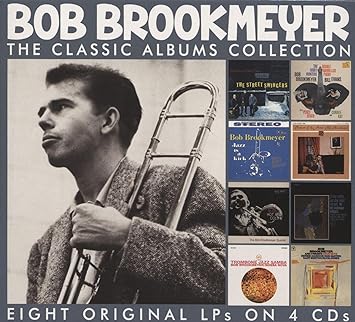
Bob Brookmeyer
The Classic Albums Collection (4 discs)
Elightenment (dist. MVD)
EN4CD9225
I can’t get enough of these Enlightenment sets, which allow me to catch up on classic albums by jazz artists that are represented only sporadically (if at all) in my collection. The latest delight in this category is this four-disc CD set that includes eight albums led by the great valve trombonist and pianist Bob Brookmeyer, all of them originally issued between 1958 and 1962. These recordings find him leading conventional big bands and small combos, but also working in unusual configurations — notably, on The Ivory Hunters, in a two-piano configuration alongside Bill Evans. The package also includes straightforward cool jazz, downright orchestral big-band extravaganzas, Latin excursions, and a whole album of small-combo blues numbers. Fellow musicians include Ron Carter, Stan Getz, Mel Lewis, Paul Motian, and many other A-list players. Brookmeyer himself is both breathtakingly virtuosic and exquisitely tasteful throughout. Any library that doesn’t already own all of these albums on CD should seriously consider picking up this set.
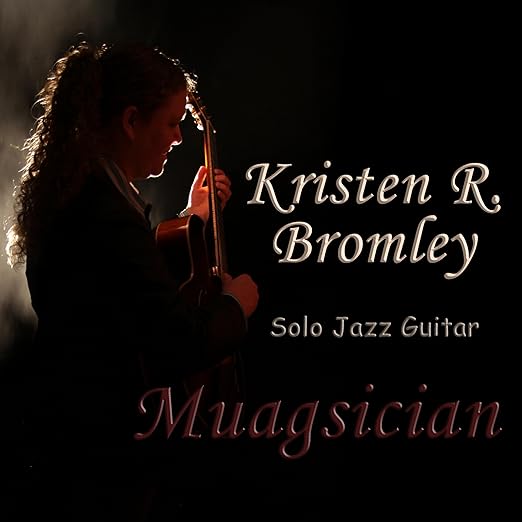
Kristen R. Bromley
Muagsician: Solo Jazz Guitar
Self-released
KRBM23001
Jazz guitarist and pedagogue Kristen Bromley has released a number of fine solo and small-combo albums, as well as five books on jazz theory and guitar technique. Her latest is a generous program of solo guitar arrangements (and a handful of guitar-vocal tunes) of jazz standards and original compositions, most of the latter on religious themes. Playing a custom Benedetto guitar, she explores a variety of tones and styles from a bluesy and straight-ahead rendition of “Summertime” to a harmonically inventive take on the German hymn tune “Lasst uns erfreuen” (known to many Protestant churchgoers as “All Creatures of Our God and King”). Along the way are sometimes tender, sometimes heartily swinging renditions of standards like “Don’t Get Around Much Anymore” and “All the Things You Are” alongside impressive and beautiful originals that reflect her deep faith. This is an unusual and very lovely effort from an outstanding guitarist.
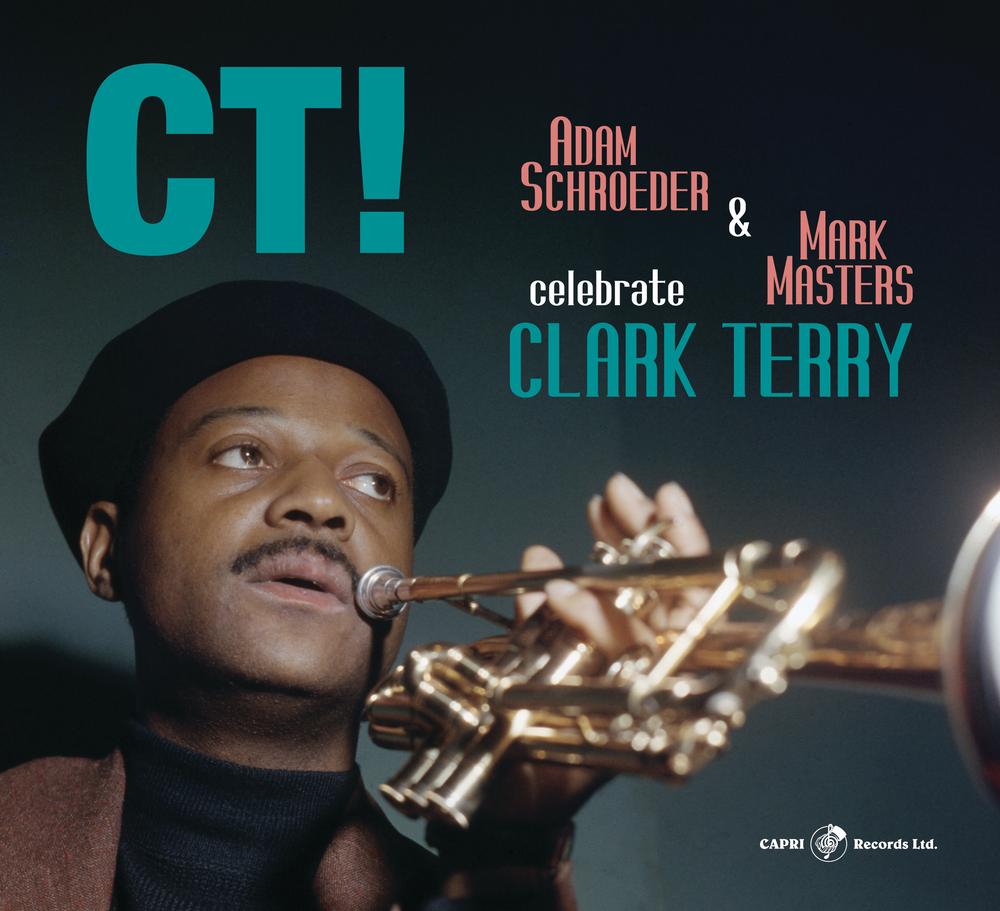
Adam Schroeder & Mark Masters
CT!: Adam Schroeder & Mark Masters Celebrate Clark Terry
Capri
74170-2
The names at the top of the masthead for this album should bring a smile to any contemporary jazz lover’s face: veteran baritone sax player and bandleader Adam Schroeder, brilliant arranger Mark Masters, and, of course, the late Clark Terry — not only a masterful bop and hard bop player and composer, but also an innovator in the use of the fluegelhorn in jazz. For this celebration of Terry’s music, Schroeder leads a big band that includes such eminent players as saxophonist Bob Sheppard and legendary drummer Peter Erskine. Unsurprisingly, the arrangements are spectacular: idiomatic, swinging, elegantly detailed. Equally unsurprisingly, the compositions are a treat, and include such favorites as “Serenade to a Bus Seat,” “In Orbit,” and a lovely arrangement of “Perdido Line” (written on the chord changes of the beloved bebop standard “Perdido”). The production quality is worth noting here as well — the band’s sound is warm, rich, and beautifully detailed. For all jazz collections.
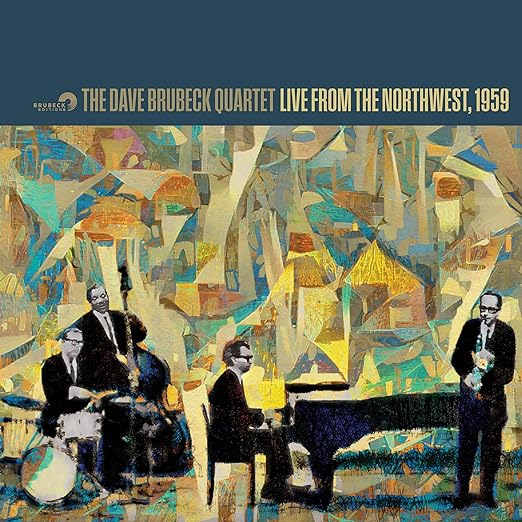
Dave Brubeck Quartet
Live from the Northwest, 1959
Brubeck Editions
BECD2310001
A few months before releasing their iconic Time Out album, the Dave Brubeck Quartet played a series of dates at the Multnomah Hotel and at Clark College, both in Portland, Oregon. Accompanying them was sound engineer Wally Heider, who had his Ampex 350-2 tape recorder, and who managed to capture both concerts in fantastic clarity and sonic warmth. The luxuriousness of the sound quality is matched by the group’s playing: this was the band at the peak of its form, bandleaders Dave Brubeck and saxophonist Paul Desmond supported by the brilliant rhythm section of bassist Eugene Wright and drummer Joe Morello. It’s hard to imagine an ensemble that better exemplified the paradoxical requirements of jazz: looseness and tightness. On (just to take one example), the Brubeck composition “Two Part Contention,” the band swings joyfully but with audible ease, Morello laying back with quiet, gentle syncopations while Desmond solos with metronomic precision. This whole album is an utter delight, and my only regret is that we don’t have a record of more than an hour’s worth of the performances.

Bill Anschell
Improbable Solutions
Origin
82886
If you ask me, the “improbable solution” at which keyboardist/composer Bill Anschell arrived in creating this album had to do with creating a program that draws equally on the straight-ahead jazz verities and on forward-thinking experimentation without sacrificing one for the other. Very few are able to strike that balance, and his achievement here is significant. Compare, for example, the rockish and melodically angular “Is This Thing Even On?” with the more conventionally jazzy “Nimbus,” and then compare both of them with the lovely “Hidden Nobility,” which blends the two approaches perfectly. Anschell has been on the jazz scene for 40 years, but his previous albums as a leader have all been acoustic affairs — this one finds him striking out in fruitful new electronic directions, and is highly recommended to all jazz collections.
FOLK/COUNTRY
The Resonant Rogues
The Resonant Rogues
Sassafras Sounds
No cat. no.
The fourth album from this band, the core of which is the singing/songwriting duo of multi-instrumentalist Sparrow and guitarist Keith Josiah Smith, finds them continuing to develop their unique blend of old-time, Cajun, and old-school Nashville sounds. You’ll hear swampy two-step (“93,500 Miles”), gentle honky-tonk (“Tell the Mailman,” “Reset My Heart”), a celebration of the Blue Ridge Mountains (“Ridgelines”), an incongruously vivacious minor-key lament (“Misery Is My Company”), and many more explorations of traditional Southern musical byways. Fine songwriting, fine singing, good production quality — what more could you ask for from indie Americana artists? Recommended.

Scott Zosel
Saturday’s Child (digital only)
Self-released
No cat. no.
“Inspired by the bold poetry of Emily Dickinson and the psychedelic country of Gram Parsons,” his Bandcamp site says, and you may think that sounds like an amazing combination or good reason to stay away — but take it from me, those influences blend with mellifluous grace in the music of singer-songwriter Scott Zosel. He crafts melodies and chord progressions that grab and don’t let go — notice in particular the first change on “Brewster’s Red Hotel,” which is about as perfect a moment as you can expect from a songwriter. The overall sound is solid but atmospheric at the same time; the songs seem simultaneously to march forward resolutely and to float just above the ground. Highlights include “Rock in a Place,” The Day My Beauty Died,” and the gorgeous “Return to Me.”
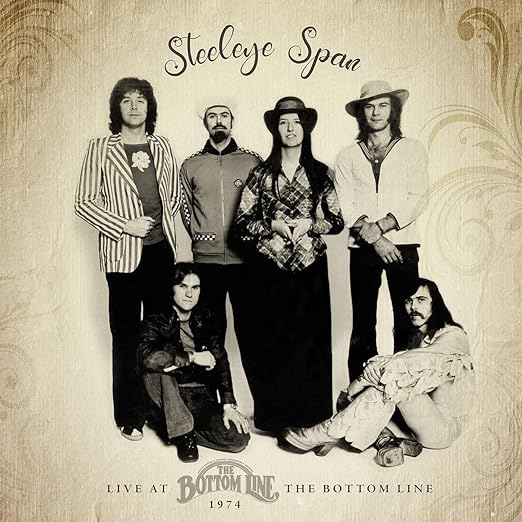
Steeleye Span
Live at the Bottom Line, 1974
Omnivore
OVCD-531
When bassist Ashley Hutchings and singer Sandy Dennis left Fairport Convention in 1970, each went their separate way — Denny to a solo career (cut tragically short by her early death), and Hutchings to the founding of Steeleye Span, which did what he had hoped Fairport would do: focus much more tightly on adaptations of traditional English music. But by 1974, when this performance at New York’s famous Bottom Line club was recorded, the band had begun moving in a more rockish direction and Hutchings had departed. Nevertheless, this album is a complete delight; the twin vocals of Tim Hart and Maddy Prior are beautifully matched, and as rockish as the performances sometimes get, there’s no question that this is a band deeply committed to sharing the joy of traditional folk music. Songs range from the very familiar (“John Barleycorn,” “Summer Is a Comin’ in”) to the quite obscure (“In Peascod Time,” “Little Sir Hugh”), and there’s a nice mix of vocal and instrumental numbers. The recorded sound is surprisingly good. Highly recommended to all folk and pop collections.
ROCK/POP
Steve Roach
Structures from Silence (reissue; 3 discs)
Projekt (dist. MVD)
416
In 1984, when Structures from Silence was first released, the line separating ambient from New Age music was a bit fuzzier than it is today, after 40 intervening years of genre fragmentation, proliferation, and redefinition. The sequentially swelling chords of the album’s three extended tracks — soft, billowing, and comforting — could easily have been taken at the time for hippie Muzak, purely functional music for blissing out. But if you listen carefully, there’s a lot more going on than that. Some of these chords are indeed simple and straightforward — and then others are complex, chromatic, and even spiky beneath the soft surface. Long stretches of contemplative gentleness are suddenly (if subtly) interrupted by rumblings of foreboding, a mood that is subsequently relieved. For this 40th-anniversary reissue, the package is augmented by two bonus discs that were originally released with an earlier reissue in 2013; these have been newly remastered for this version.

bvdub
Asleep in Ultramarine
Dronarivm
DR-91
The projects of Brock Van Wey (a.k.a. bvdub), on the other hand, are unlikely ever to be mistaken for New Age music. His latest, a single 79-minute track, is an expression of what he calls (perhaps with his tongue somewhat in cheek) “a life of consuming madness continuing its guise as grand artistic vision.” Where much ambient music defines huge and echoing sonic spaces, Asleep in Ultramarine is dense and can feel almost claustrophobic at times: its various elements, which include shuddering sub bass passages, eerie vocal samples, and radically treated chords, all crowd together into a single dark and unsettling mass of sound. This is ambient music for a very different kind of ambience than most listeners would expect — and it’s also a master class in sound sculpture.
The Green Kingdom
Ether Hymns
Dronarivm
DR-90
Another release from the outstanding Dronarivm label is the latest from composer/producer Michael Cottone, doing business as The Green Kingdom. This one is much gentler and more inviting than the bvdub album, but no less carefully crafted or artful. Here there are occasional appearances of recognizable instruments (mainly guitar) and even a regular rhythm or two — though nothing that could reasonably be called a “beat,” let alone a “groove.” The point is to explore “the manner in which the sounds and patterns that form a piece of music are brought into existence from nothingness” and the ways that they “evolve over time and drift off like clouds on the wind.” Most of this music is ephemeral in that way — the way clouds are ephemeral, appearing solid and real but constantly shifting and eventually disappearing. The music is gorgeous.
Aria Rostami & Daniel Blomquist
Midbreath (digital & cassette only)
Self-released
1108
Dedicated to the memory of the late film composer and synth pop artist Ryuichi Sakamoto, this brief album (released only in digital format and as an elaborately packaged, limited-edition cassette — only two copies of which are still available as of this writing) conveys a deep sense of sadness and loss. Central to the music’s sound is a minimally played piano, but around the piano are draped garlands of surface noise, glitch, arctic winds, and occasional haunting voices recorded as if from an echoing distance. Those familiar with the work of Aria Rostami will know pretty much what to expect — his music is minimal and spacious, but also tends to pack a surprising emotional punch. That’s definitely the case with this one. The available formats make it a somewhat awkward prospect for library acquisition, but librarians with an interest in ambient and minimal music may want to acquire their own copies.
Eraldo Bernocchi & Hoshiko Yamane
Sabi
Denovali
DEN383
Those who follow film music may recognize the name of Eraldo Bernocchi, though many more than that have heard his work presented anonymously in advertisements and multimedia projects, or in conjunction with artists like Harold Budd, DJ Olive, and dark-ambient legend Mick Harris. On Sabi he’s collaborated with Tangerine Dream violinist Hoshiko Yamane to create a series of electroacoustic meditations on the Japanese concept of sabi, a word that denotes beauty in impermanence or decay. A blend of mournfulness and hope characterizes the dark and lovely music on this album, music that sometimes pulses gently but more often floats and then falls apart in shreds. The violin is sometimes recognizable as such, and sometimes not, but every track is genuinely lovely.
WORLD/ETHNIC
Nadah El Shazly
Les Damnés ne pleurent pas (digital & vinyl only)
Asadun Alay
No cat. no.
Alternately spooky, forbidding, and blissfully delicate, this score was written to accompany Fyzal Boulifa’s film Les Damnés ne pleurent pas (“the damned don’t cry”). Singer-composer Nahad El Shazly made extensive use of improvisation while creating the score, drawing on the talents of violinist Nicolas Royer-Artuso, bassist Jonah Fortune, and harpist Sarah Pagé; the latter’s harp is recorded both acoustically and with the use of subtle electronic modulations and distortions. All of the music is eerily beautiful, but the real highlight moments are when El Shazly herself is singing — her voice is a crystalline wonder, and the melodies she has written are quietly ravishing. Libraries that collect film music should take a particular interest in this release.
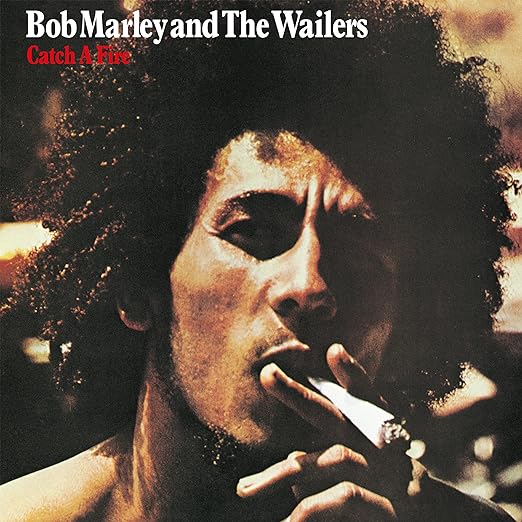
Bob Marley & the Wailers
Catch a Fire (reissue; 3 discs)
Tuff Gong/Island
5565983
Fifty years ago, Catch a Fire was released — it was Bob Marley & the Wailers’ first record for Island, and is widely considered to be the album that brought reggae music to serious international attention for the first time. Listening to it today, it’s easy to see why: the program is heavy with genre-defining classics, including “Concrete Jungle,” “Stir It Up,” and “Slave Driver.” (There are also a couple of moments of irrelevant silliness, notably including the slightly embarrassing “Kinky Reggae.”) This was the period during which the Wailers included Peter Tosh and Bunny Wailer as well as Bob Marley, and they were magnificent together. This deluxe reissue includes two bonus discs — one documenting a live performance at London’s Paris Theatre in 1973 (complete with a British MC making charmingly clueless comments between songs), and the other, even better, featuring extended disco mix versions, alternate mixes, and a handful of additional live tracks. Strongly recommended to all libraries.

Rootz Radicals
Together As One (vinyl & digital only)
Self-released
RRTA1
Germany continues to put Jamaica to shame as a producer of top-notch contemporary roots reggae. The long-awaited debut album from Rootz Radicals demonstrates that you don’t have to hail from sunny Caribbean climes to deliver convincing roots, dancehall, and rock steady grooves — tracks like “Mango Juice” and the conscious anthem “Education Free” (featuring guest singer Queen Omega) draw deeply on reggae tradition, while the band’s collaboration with celebrated reggae deejay Gentleman shows them to be adept in a more up-to-date, hip-hop-inflected mode as well. Other highlights include the tight-as-a-drum “Kinky Paradise” and a charming cover of Rod Stewart’s 1970s schlock classic “Maggie May,” which benefits mightily from its recasting here as a one-drop anthem on which the interaction between spare drums and chugging Hammond organ is particularly effective. For all library collections.
 CD HotList