CLASSICAL
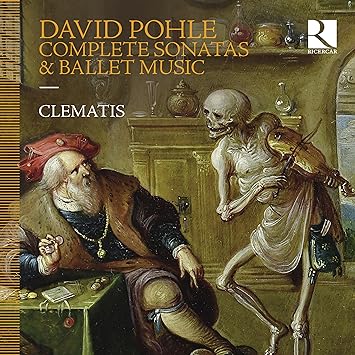
David Pohle
Complete Sonatas & Ballet Music (2 discs)
Clematis / Sailly & De Failly
Ricercar (dist. Naxos)
RIC 460
Until recently, none of the music of prolific Dresden composer David Pohle (1624-1695) had ever been published; most of his music has been lost, and those compositions that have survived (in many cases only partially), were to be found only in manuscript collections scattered around Germany. But the publisher Prima la musica has recently published editions of all of Pohle’s known surviving vocal and instrumental works, and this recording by the outstanding Clematis ensemble is one result. Copying errors have been corrected and missing parts reconstructed, and now you can hear 29 sonatas and two dance suites that show Pohle to have been a master of the German style, and that also reveal the influence of his teacher, Heinrich Schütz. I see no indication in the information provided that these are world-premiere recordings, but while a handful of Pohle’s chamber works have been recorded elsewhere, I suspect that many of the pieces featured here are in fact first recordings. For all libraries with a collecting interest in baroque music.

Various Composers
Butterfly Lovers
Joshua Bell; Singapore Chinese Orchestra / Tsung Yeh
Sony Classical
19658810972
The title work on this disc is a well-known mid-20th-century concerto for violin and orchestra by the composers Chen Gang and He Zhanhoa, written when both were students at the Shanghai Conservatory of Music. The music is somewhat programmatic; it’s meant to illustrate a story of doomed love, and it has been very popular since its original publication. For this recording, violinist Joshua Bell turned to a different arrangement of the piece written for an orchestra that includes traditional Chinese folk instruments. The result is not only a very pleasing sound but also a fascinating example of East-meets-West orchestration that will be of particular interest to students and pedagogues. The program is rounded out with familiar pieces by Saint-Saëns, Massenet, and Sarasota. As always, Bell’s tone is golden and luminescent, and the orchestra is beautifully recorded.
Various Composers
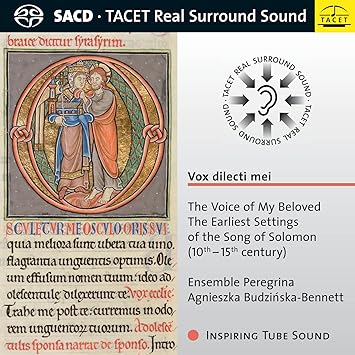
Vox dilecti mei: The Voice of My Beloved — The Earliest Settings of the Song of Solomon (10th-15th Century)
Ensemble Peregrina / Agnieszka Budzińska-Bennett
Tacet (dist. Naxos)
S 270

Various Composers
Ave maris stella: Chants from St. Bridget’s Sacred Liturgi [sic]
Schola Gothia
Footprint (dist. Naxos)
FR137
Both of these albums explore medieval sacred music written (primarily) for women’s voices — presented, in both cases, in something very like the four-female-voice format made popular by the highly successful Anonymous 4 in the 1980s and 1990s. With Vox delicti mei, Ensemble Peregrina present a selection of motets, responsories, and antiphons on texts from the Old Testament Song of Solomon and collected from abbey and monastery archives around Europe, many of them never recorded before and likely not heard in hundreds of years. Some are by known composers (two are generally attributed to Hildegard of Bingen) but much of this music is of unknown origin; some is relatively simple and some requires exceptional vocal skill. Most is plainchant, but there’s some astringent early polyphony in the mix as well. Ensemble Pelegrina sing with absolutely transparent blend and a light, unearthly tone. While some of the material on Vox delicti mei was used in the context of Marian devotion, all of the music on Ave maris Stella was written for that explicit purpose. This program consists of material taken from the Cantus sororum collection at Vedstena Abbey, an institution of the Bridgettine order of nuns; the music was all written during the time of St. Bridget in the 14th century. Again, here we have a collection of antiphons, sequences, responsories, and hymns, but in this case the music is all monophonic. The four-voice Schola Gothia ensemble have chosen a highly resonant space in which to record this music, lending the singing a hushed and reverent air that goes perfectly with the material; their voices are quietly magnificent.
Steve Reich
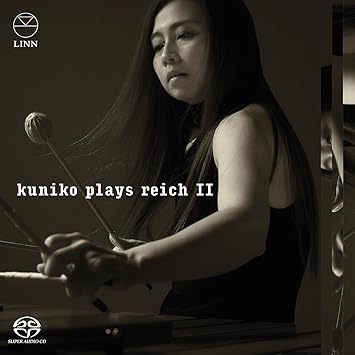
Kuniko Plays Reich II
Kuniko
Linn (dist. Naxos)
CKD 712
Having raved about marimba virtuoso Kuniko’s first recording of music by Steve Reich, I was very excited to see a second one being released — and then was brought up short when I noticed the first piece on the program is his Four Organs, a work that exemplifies the meeting of first-generation minimalism and 1960s-era avant-garde musical provocation. For one thing, I wondered how she was going to play the piece on the marimba, an instrument that doesn’t really permit the variations in chord length required for the work. The answer, it turns out, is that she doesn’t; she plays it as written, but as a soloist on overdubbed organs and maracas. The rest of the program makes more obvious sense: an arrangement for overdubbed vibraphones of Piano Phase, a gorgeous rendition of Nagoya Marimbas (a work that I’ve always wished was longer), and the brilliant Mallet Quartet (for two vibraphones and two five-octave marimbas). As always, Kuniko plays not only with virtuosic skill but with a deep emotional connection to Reich’s music. Here’s hoping for a third volume.

Sarah Hennies
Motor Tapes (2 discs)
Various Performers
New World
80844-2
This two-disc set includes three works by Sarah Hennies: on the first disc are Zeitgebers (for field recording and percussion) and Clock Dies (a chamber work performed by Talea Ensemble); on the second disc is her largest-scale and most ambitious work to date, a nearly hour-long piece titled Motor Tapes, which was commissioned by Ensemble Dedalus. All of the music was written within the past several years, and it illustrates an evolution in Hennies’ compositional approach. The two works for live ensembles, in particular, present recent developments — Talea Ensemble works with a conductor, and Hennies characterizes Clock Dies as her first attempt at writing “normal” music; Motor Tapes, on the other hand, is also through-composed but is structurally quite complicated, and although the music can sound a bit pointillistic the structure does come through as you listen. Particularly effective are the unpredictable irruptions of consonant chords during otherwise random-sounding passages of quiet percussion and muted brass.
JAZZ
Arve Henriksen & Harmen Fraanje
Touch of Time
ECM
2794
I can imagine that trumpeter Arve Henriksen’s approach might not be everyone’s cup of tea: his tone is hushed and often quavery, and his approach to melody can be discursive to the point of meandering. And yet the music he makes is captivating, and on this collaborative album with pianist Harmen Fraanje it’s quietly spectacular. As usual, Henriksen supplements his trumpet playing with live electronics, though they’re wielded very subtly. Free improvisation and composition nestle snugly together here: “The Beauty of Sundays” and “Redream” are obviously carefully written and structured, while “Mirror Images” floats impressionistically on a warm bed of synth tones and sounds much more improvised — Henriksen’s eerie, modal trumpet line winds sinuously above Fraanje’s unsettled chords. The whole album can function as ambient music if you like, but also rewards close listening. My only complaint is the album’s rather stingy 38-minute running time. Recommended to all adventurous jazz collections.
Acceleration Due to Gravity
Jonesville (vinyl & digital only)
Hot Cup
232
The second release from bassist Moppa Elliott’s nonet Acceleration Due to Gravity is a celebration of the music of bassist/composer Sam Jones (most famous for his work alongside Cannonball Adderley during the hard bop period). But while the band’s overall sound harks back to the glory days of 1960s jazz, the structure of these performances is resolutely odd: Elliott organizes Jones’ themes into loops that repeat and vary, and while there are solo sections carved out of the arrangements there are no standard “chorus-solos-chorus” structures. The sound is particularly unsettling when hot jazz and jump blues grooves are undermined by this odd approach to arrangement (note “Miami Drag” for a great example), but it all manages to be more exciting than irritating. There are four Elliott originals on the program, all of which are deeply inspired by Jones’ music. Once again, though, at 22 minutes in length this album feels strangely and unnecessarily truncated. (The list price does seem to reflect its brevity.)
Koppel Blade Koppel
Time Again
Cowbell
89
As an ensemble, saxophonist Benjamin Koppel, organist Anders Koppel (Benjamin’s father) and drummer Brian Blade comprises something of a power trio — each of them is a titan on his home scene, and the word “power” is what kept coming to my mind as I listened to this stellar album. “Puerto Rican Rumble” opens things with a bang: Benjamin’s saxophone wails and shouts while Anders’ Hammond organ pushes the music solidly from below and Blade plays skittery, nervous, jungly funk beats. On the ballad “If You Forget Me,” Benjamin digs deep into a blues/R&B bag and Anders’ tone gets particularly churchy; the very long “Bazaar Revisited” is quite episodic, moving from contemplative ballad passages to an extended jump-up bop section, and, as its title suggests, nods towards Middle Eastern tonalities (am I mistaken, or is it based at least in part on the “A Night in Tunisia” changes?). The album’s title track is straight-up funk, and features a surprisingly effective rap interlude with Al Agami. This is not your granddad’s jazz album, even if one of the players could literally be your granddad.

Antonio Adolfo
Love Cole Porter
AAM Music
AAM 0718
Everyone appreciates Cole Porter’s acerbic sense of humor; the witty lines from his songs could fill a book (other than the Great American Songbook, that is, which is already full of them). But we shouldn’t overlook his gifts as a melodist, or his more subtle achievements in harmony and song structure. With this album, Brazilian pianist and arranger Antonio Adolfo pays particular tribute to these aspects of Porter’s genius, demonstrating not only the sophistication of his writing but also its adaptability. For this program he selected songs that can fit particularly comfortably in Latin jazz settings, making use not only of familiar Brazilian genres like bossa nova and samba, but also toada, ijexá, and quadrilha. These subtleties may be lost on the average listener, but what’s clear is the skill and the care Adolfo has put into these arrangements, which are endlessly delightful: from the laid-back toada/bossa mashup of “I’ve Got You Under My Skin” to the sprightly frevo and quadrilha of “Just One of Those Things,” the album never stops being both fun and impressive — exactly what one would hope for in any Cole Porter tribute.

Jazz at the Ballroom
Flying High: Big Band Canaries Who Soared
Self-released
No cat. no.
“Canary” is a — shall we say — outdated term for the female singer in a big band. With this album, a nonprofit educational/performing collective called Jazz at the Ballroom seeks to celebrate the work of these singers and of the musical era in which they came to prominence. Featuring familiar standards like “I Only Have Eyes for You,” “Tea for Two,” and “What a Difference a Day Makes” and an array of singers that includes Jane Monheit, Vanessa Perea, and Carmen Bradford (among others), this disc is a magnificent look back at a golden era of American music. Best of all, it prominently features the brilliant Champian Fulton, who plays piano on all tracks and sings on several. Although these tunes were made popular during the big band era, here the singers are accompanied by a piano trio, which means that Fulton’s unique phrasing and limitless melodic invention are a rich through-line for the whole program. Any library that supports jazz pedagogy should jump at the chance to acquire this wonderful album.
FOLK/COUNTRY

New Riders of the Purple Sage
Hempsteader: Live at the Calderone Concert Hall, Hempstead, New York, June 25, 1976
Omnivore
OVCD-542
This generous live set from the legendary country-rockers New Riders of the Purple Sage covers a lot of ground: bluegrass classics (“Ashes of Love,” “Panama Red”), vintage honky tonk (“Honky Tonkin’ [I Guess I Done Me Some]”), a lovely piece of Hazel Dickens country-feminism (“Don’t Put her Down”), a yodeling showcase (“Little Old Lady”), and even a Rolling Stones cover (“Dead Flowers”). The singing is sometimes shaky, but instrumentally the band is in fine fettle — the steel guitar playing of Buddy Cage is especially impressive throughout, and whoever was on the mixing board kept him nicely front and center. The band’s energy and good humor are also a constant, and make this album a lot of genuine fun even when the singing leaves something to be desired.
Ralph Stanley and the Clinch Mountain Boys
1971-1973 (reissue; 4 discs)
Rebel
REB-CD-4001
Of course, if what you want is consistently fine — by which I mean hair-raisingly perfect — singing, then what you need is an album by the late Ralph Stanley. Or, even better, a four-disc set that collects a full eight albums he recorded in the early years of the 1970s. Originally issued in 1995, this box set has now come back to market and is a goldmine for any library that collects bluegrass or country music. Across its 90 tracks, from the reedy power of gospel material like “I Am the Man, Thomas” and the simply astonishing “Bright Morning Star” to the clawhammer banjo raveups “Little Birdie” and “Shout Little Lulie,” the highlights are too numerous to mention. Of course, it helps that during this period Stanley had both Ricky Skaggs and Keith Whitley in his band, both of whom were not only ridiculously talented but also longtime devotees of the music Ralph had made earlier in his career with his brother Carter, and who knew their book and understood the Stanley sound all the way down in their bones. This is simply a treasure trove of magnificent music.

Martha Fields
Bramble Bridge
Self-released
No cat. no.
Martha Fields’ family heritage is rooted in both Appalachia and Texas/Oklahoma; interestingly, she now seems to be based in France — or at least she’s been spending an awful lot of time there, touring Europe with her backing band of French musicians. Her songs are informed by the mountains of the American Southeast but also the prairies of the southern Midwest — and sometimes the Missisippi Delta. Her voice is startlingly deep and richly expressive and her stylistic range is impressive: “Nightrider Blues” has a Chicago vibe, while “Party Marty” boasts a funky Memphis vibe and “Irene’s Mountain Railway” is a country-rock lament that Steve Earle would kill for. When she’s not writing her own material she’s creating tasteful arrangements of classic traditional material like “Wayfaring Stranger,” of which she delivers a deeply haunting version here. And every one of her backing musicians sounds like he could have honed his chops in Nashville or Austin. Recommended.
ROCK/POP

Banco de Gaia
Trauma
Disco Gecko (dist. MVD)
GKOCD042
Toby Marks, doing business as Banco de Gaia, has been a major force in contemporary electronic music for decades, but this is his first full album of new material in eight years. As its title suggests, the issues and concerns that gave rise to this release are deep and troubling: unsettled (and unsettling) political trends, wars raging around the world, and environmental decay were on his mind as he wrote and produced this music, but so were more intimate and domestic concerns as significant as the declining health of his parents and as apparently insignificant as a bee sting. On “War,” a throbbing house beat underlies alternating male and female voices asking (“What’s the question?”) and answering (“War”) each other; “My Little Country” uses found-sound narrative and another four-on-the-floor groove to explore themes of greed and history; on the other hand, the funkier and more atmospheric “Mo Dhia” emerges from an impulse to explore and embrace the infinite and eternal. As always with this artist, the production is rich and detailed and the grooves are indelible.
MIZU
Forest Scenes (cassette/vinyl/digital only)
NNA Tapes (dist. Redeye)
NNA 153
This is one of those rare releases that could arguably have been placed in either the Pop/Rock or the Classical section. (When press materials refer to the music as a “headlong dive into deconstructionist experimentation and ontological interrogation,” maybe that’s a signal that you shouldn’t waste too much time worrying about genre boundaries.) In any case, MIZU is a classically-trained cellist whose compositions draw on the cello for many of their sound sources but then expand, multiply, and elaborate upon those sounds in radical ways, bringing in other electronic material as well. For example, note how “Pavane” takes long bowed tones from both the bottom and the top of the neck, alters them with electronic effects, and weaves them among pulsating rhythmic lines. “Flutter,” on the other hand, juxtaposes rather than incorporates: conventional legato cello lines peek through a dense foliage of pitched and unpitched electronic sounds, while MIZU gently taps and pats the cello to create percussive effects. This is highly atmospheric music, but it’s also just a bit confrontational.
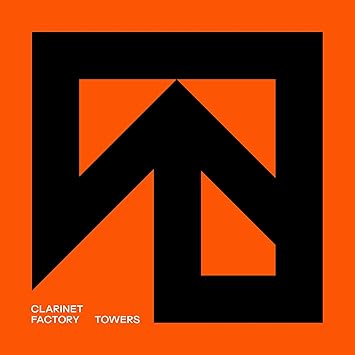
Clarinet Factory
Towers (2 discs; LP & digital only)
Supraphon (dist. Naxos)
SU 6920-1
While we’re talking about releases that could fit as easily in the Classical as in the Rock/Pop (or, frankly, the Jazz) section, here’s the latest from the Prague-based ensemble Clarinet Factory, a quartet of clarinetists who not only perform in top-notch classical ensembles but also work together to expand the technical possibilities of the instrument while also fuzzifying the boundary line that separates popular from art music. On Towers we get jazz-funk with Czech vocals (“Obloha Sea,” the album’s lead single); a lush 12/8 instrumental with layers of sweet and gentle clarinets and keyboards, which the title (“Drufolk”) suggests may be derived from a traditional melody; a sort of pop-minimalist meditation (“Eliska”); and a softly thumping dance number titled “Joy Machine” that features shimmering layers of clarinets and dubwise production techniques. This album is unlike any other you’ll hear this year, and it’s a delight.
Peel
Acid Star
Innovative Leisure (dist. Redeye)
IL2213
When drummer Isom Innis and guitarist Sean Cimino were working on their debut as a duo, they decided to channel the bands they loved as kids, before they had “any taste or judgment,” as they puckishly put it. What’s the result? An album of dream pop crossed with electro pop crossed with — I’m not kidding — industrial (come on, listen to the vocals on the chorus of “Y2J,” not to mention the squidgy [and possibly ironic] Front 242 synths on the bridge of “Mall Goth”), music that evokes a particular time and place without sounding like slavish revivalism. You’ll hear cascading sheets of melodic shoegaze (“Manic World”), blippy Casiotone funk (“In the Sedentary”), swirly multilayered guitar pop (“OMG”) and much more (including harpsichords!). If you were listening to a lot of stuff on the Creation label back in the 1990s, you’ll likely vibrate to much of those album — but again, these guys aren’t revivalists. They’re just pursuing their bliss, and if you follow them you’ll probably find some too. For all libraries.
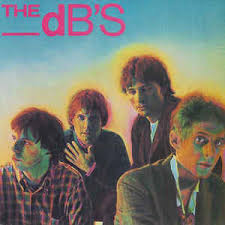
The dB’s
Stands for deciBels (reissue)
Propeller Sound Recordings
PSR 018
Recorded and originally released in 1981, before the music industry threw up its hands and coined the term “indie” to describe uncategorizable scrappy post-punk pop music, the debut album by The dB’s still sounds original, forward-thinking, and, frankly, weird today. Jangly, yes, but not in a straightforward hey-remember-the-Byrds? kind of way, it twitches more than it dances and pokes more than it caresses. Listen to the whiny harmonies on “Dynamite” or the subversion of Beatlesque baroque chord progressions on “She’s Not Worried,” and you’ll hear hints of both REM and The Apples in Stereo to come; listen to the amphetamine twitch of the Latin beats on “Cycles Per Second” and you’ll hear something probably unlike anything you’ve heard elsewhere. Guitarists/singers Pete Holsapple and Chris Stamey would go on to shape significantly the sound of 1980s Athens, Georgia, which would in turn hugely influence pop music for the rest of the decade; for now, though, they just sound like a bunch of precociously talented weirdos having an awesome time.
WORLD/ETHNIC
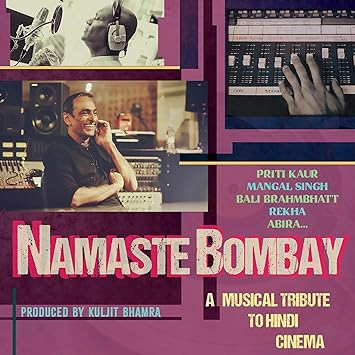
Various Artists
Namaste Bombay: A Musical Tribute to Hindi Cinema (2 discs)
ARC Music (dist. Naxos)
EUCD2952
Some of the world’s best pop music is being made in India. I’ll go further, actually, and assert that some of the best pop music of the past six or seven decades has been made in India — and will note further that it is almost invariably film music, Bollywood films having been for many years the primary dissemination channel for Indian pop songs. Namaste Bombay, a collection of new songs composed and arranged by the legendary film music producer Kuljit Bhamra, is a celebration of this tradition. Drawing on the talents of a large population of singers, lyricists, and instrumentalists, Bhamra has created a colorful and engaging set of songs that demonstrate not only how Indian film music has seamlessly incorporated classical and pop elements, but also how well it has absorbed musical influences from around the globe — note the flamenco flourishes in “Hum Dewayne Hai,” for example, and the way that “Kaise Kate Ye Raat Din” blends trad Hindi film music conventions with straight-up funk. Traditional orchestras make space for breakbeat samples, and classically trained singers deliver swooning songs of romance. This very generous program is a pleasure from beginning to end.

Various Artists
Ghana Special, Volume 2: Electronic Highlife & Afro Sounds in the Diaspora 1980-93 (2 discs)
Soundway (dist. Redeye)
SNDWCD148
The conventions of Ghanaian highlife music were well established by 1980, and artists like Pat Thomas and Rex Gyamfi were stars in their homeland. But migration led, as it always does, to musical evolution, and as Ghanaian musicians spread throughout Europe and North America during the following decade they came into contact with new musical styles (and technologies) that influenced their subsequent work — in fact, the term “Burger Highlife” was coined to describe highlife music made by Ghanaian immigrants to Germany. Thus, on this collection, we hear Gyedu-Blay Ambolley purveying funk that could have come out of Detroit or maybe even Minneapolis (“Apple”), Nana Budjei creating West African-inflected reggae (“Asobrachie”), Pepper, Onion, Ginger & Salt rapping in English (“M.C. Mambo”), and much more. These are rare tracks that will make a welcome addition to any library collection dealing with African and/or international pop music.

East of the River
Ija Mia: Soundscape of the Sephardic Diaspora
Avie (dist. Naxos)
AV2665
Recorder players Daphna Mor and Nina Stern lead the East of the River ensemble, and on their latest album they celebrate their ethnic/regional heritages — Mor coming from a Ladino (Hispano-Jewish) background, and Stern from a family of Venetian Jews. Unlike the Ashkenazi Jews of northern and eastern Europe, Mor’s and Stern’s ancestors were Sephardim who came largely from the Middle East and North Africa and settled primarily in and around the Iberian peninsula, bringing with them songs and tunes that were heavily influenced by a musical culture they shared with Arabs of those regions. On this collection you’ll hear Jewish prayers accompanied by the oud and the qanún, as well as keening clarinets that evoke klezmer music and rhythms that anticipate tango and flamenco. Some of the singing is in Spanish, some in Hebrew. All of it is hauntingly lovely.
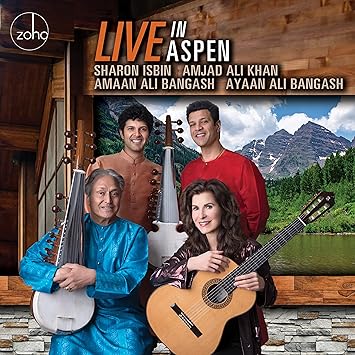
Sharon Isbin; Amjad Ali Khan; Amaan Ali Bangash; Ayaan Ali Bangash; Amit Kavthekar
Live in Aspen
ZOHO (dist. MVD)
ZM202405
Given the importance of microtonal melodic variation in Indian classical music, one wouldn’t think that the western guitar would lend itself well to that context; note-bending is always a possibility, but less so with a nylon-string classical guitar that with a steel-string folk guitar. So when I first encountered this ongoing project of classical guitarist Sharon Isbin and the illustrious sarod player Amjad Ali Khan and his sons, I was perplexed but fascinated. And to my delight, their Strings for Peace album was outstanding; it achieved an East-West fusion in a truly seamless way that managed never to condescend to either tradition and bring out the best in all involved performers. This live recording does the same; it opens with Isbin, alone, performing a standard Spanish classical work, but then proceeds to offer both traditional ragas and original works for guitar and sarod composed for the ensemble by Khan. This album makes an excellent companion piece to the group’s previous studio effort.
 CD HotList