CLASSICAL
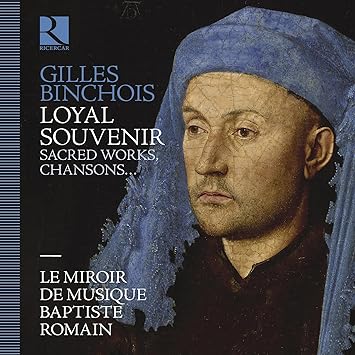
Gilles Binchois
Loyal Souvenir: Sacred Works, Chansons
Le Miroir de Musique / Baptiste Romain
Ricercar (dist. Naxos)
RIC473
Gilles Binchois, along with Guillaume Du Fay, is one of the two towering figures of the early 15th-century Burgundian school of choral music. Like Du Fay, he wrote in a transitional style that anticipates the coming lushness of Franco-Flemish polyphony but still has one foot in the open, astringent harmonies of the late Medieval period. This wonderful album by the Miroir de Musique ensemble brings together ballades, rondeaus, chansons, and Mass sections drawn from multiple sources and from different points in Binchois’ career, providing a nice overview of the formats and structures in which he was comfortable and the stylistic variations that came into play as he developed as a composer: you’ll hear tight polyphony as well as examples of pieces in which the high voice moves with great independence; you’ll also hear instrumental arrangements interspersed among the vocal performances. On a less technical and more subjective level, there’s a certain sadness to this music, which is deepened by the vinegary post-Ars Nova harmonies. Le Miroir de Musique perform sensitively and with exquisite blend and intonation.
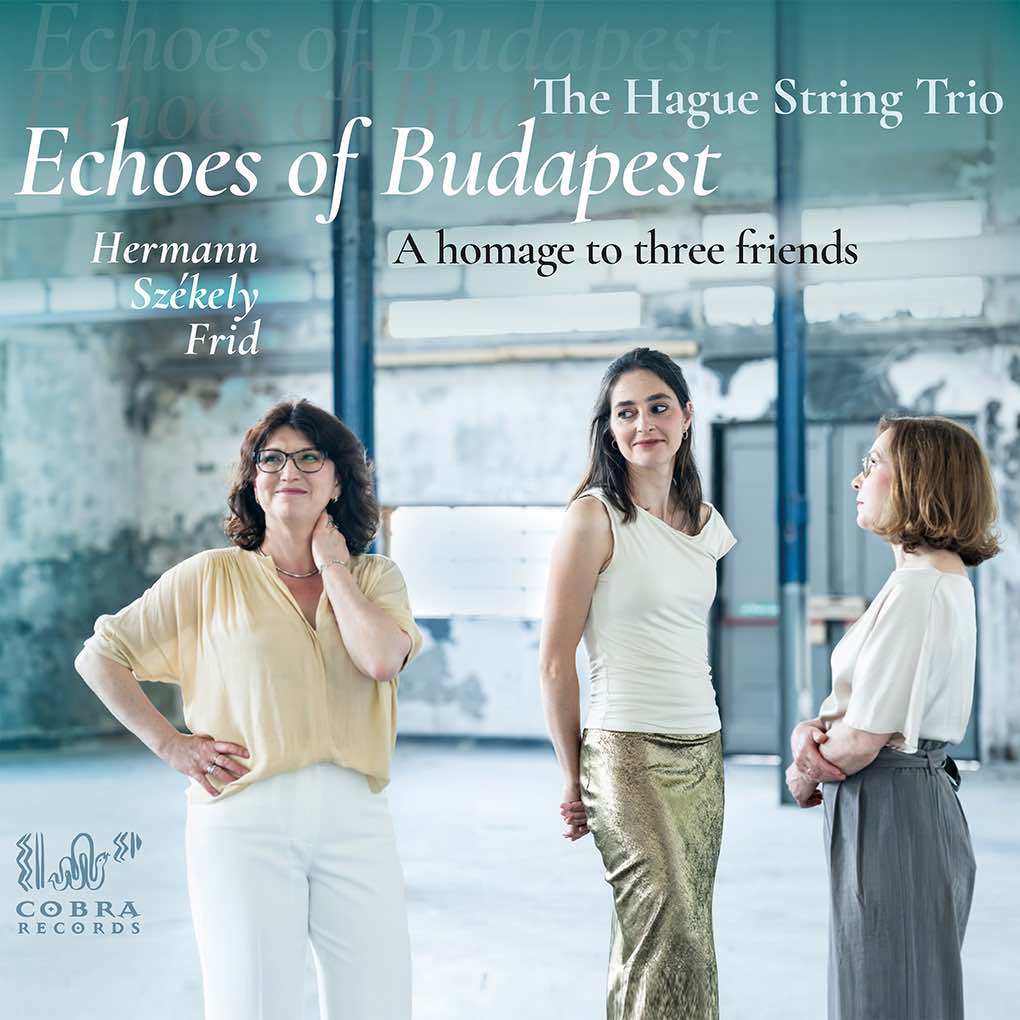
Pál Hermann; Géza Frid; Zoltán Székely
Echoes of Budapest
The Hague String Trio
Cobra
0096
The three composers represented on this recording were all friends at the Franz Liszt Academy in Budapest in the early 20th century, a period during which European academic musical style was turning away from emotionally demonstrative Romanticism and embracing a new structural rigor and intellectualism. Two of the featured works (Géza Frid’s Duo for Violin and Cello ‘Kan-Ti’ and Zoltán Székely’s String Trio) are presented in world-premiere recordings. Also on the program are Frid’s String Trio, op. 1 and Pál Hermann’s String Trio, all written during the 1920s. Hermann’s piece (an unpublished student work) opens in a spiky, high-modernist mode before lapsing temporarily into a relaxed but jaunty lyricism; Frid’s Duo, with its repetitive figures and octave unison passages, prefigures first-generation minimalism, while I swear I hear anticipatory echoes of Carl Stallings in the Székely piece. All of is is played with bracing vigor and fearsome technique by The Hague String Trio.
Christoph Graupner et al.
Into the Light: Rediscovered Chamber Music by Christoph Graupner and Others
Musicians of the Old Post Road
OPR Recordings
OPR001
There are even more world-premiere recordings on this next album — in fact, it consists entirely of first recordings of recently rediscovered chamber music by Christoph Graupner, Johann Friedrich Fasch, Ernest Louis, and Georg Philipp Telemann. (The Telemann inclusion surprised me, so I dug a little deeper: the D-minor quartet performed here is actually well attested as part of Telemann’s monumental Tafelmusik collection; however, this is the first recording of a 1742 version of the quartet published in Paris, with the flute taking the place of the first violin.) The featured works consist of quartets, sonatas, a movement from a suite by Graupner’s patron, Ernest Louis Landgrave of Hesse-Darmstadt, and a small-scale flute concerto. The music itself is consistently winning and will be of particular interest to any library that focuses on music of the baroque period, and I was especially impressed by traverso player Suzanne Stumpf, whose tone and expression are a consistent highlight. I only wish her flute were a bit more forward in the mix.
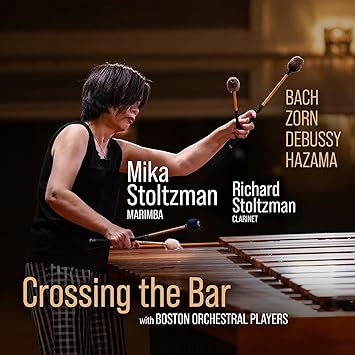
Various Composers
Crossing the Bar
Mika Stoltzman; Richard Stoltzman et al.
Avie (dist. Naxos)
AV2807
Mallet keyboardist Mika Stolzman is married to world-renowned clarinetist Richard Stoltzman, and this winning collection of works both old and new is a collaborative effort between them. It opens with an arrangement for marimba and strings of J.S. Bach’s Chaconne in D Minor from Partita No. 2, then moves — a bit abruptly — to a much more modernist place: a trio for marimba, clarinet, and cello written for her by legendary downtown enfant terrible John Zorn (though at this point I guess we could call him more of an éminence grise terrible). We then hear a limpid and lovely arrangement of Claude Debussy’s Rêverie for marimba and strings, and then a thrilling new work: a commissioned concerto for marimba, orchestra, and jazz rhythm section written by the young Japanese composer Miho Hazama. The album offers a richly varied program of seriousness and whimsicality, all of it played with not just virtuosity but also deep feeling and musical insight. I particularly recommend this album to anyone who has yet to encounter Bach (or Debussy) on the marimba.
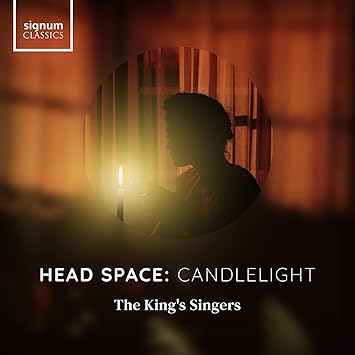
Various Composers
Head Space: Candlelight
The King’s Singers
Signum Classics (dist. Naxos)
SIGCD950
The title of the latest album from the world-renowned King’s Singers perfectly conveys its mood: if you want to immerse your “head space” in a “candlelight” sort of vibe, it’s hard to imagine a more effective tool than this. The program consists of works both ancient and modern, all of which convey a sense of quietude and contemplation, though in a wide variety of ways. Judith Bingham’s setting of Ave virgo sanctissima is both very modern and very accessible — simultaneously eerie and deeply spiritual, its harmonic movement more floating and evanescent than linear and obviously logical. There are plainchant selections and works by Arvo Pärt, Robert Parsons, and others, all of which have different flavors; the wordless arrangements of Orlando Gibbons’ numbered songs interspersed throughout are particularly sweet and simple. I’m unconvinced that including John Cage’s infamous 4’33” (a silent piece composed entirely of rests) was a great idea; I’m sure it’s very effective in a live context, but for a recording, it comes across as an annoying affectation. Skip that track, though, and you have a magnificent album.
JAZZ
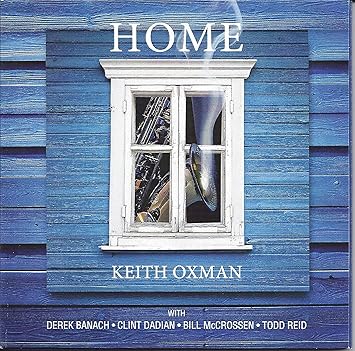
Keith Oxman
Home
Capri (dist. MVD)
74177-2
Every time a Capri Records release shows up in my mailbox, I think “Oh, goody.” And I’m almost always right. In the case of tenor saxophonist Keith Oxman’s latest album as a leader, all my expectations were borne out and then some. Possessed of a powerful but refined tone, an equally powerful sense of swing, and magnificent compositional chops, Oxman is (in my view) one of America’s leading lights in the field of straight-ahead jazz, and I think anyone who gives this album a spin will agree. Here he leads a classically configured tenor-trumpet quintet that includes trumpeter Derek Banach, guitarist Clint Dadian, bassist Bill McCrossen, and drummer Todd Reid, bringing us an almost all-original program (there are two standards) that pays homage to his family, friends, and musical mentors. Highlights are tough to identify because the album is so consistently fine, but I was particularly impressed by the harmonically complex but straightforwardly swinging “True Lou” and the blues-adjacent “Don’t Throw in the Powell.” Highly recommended to all libraries.
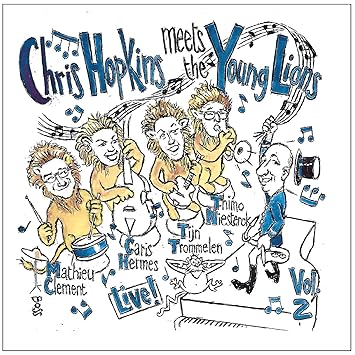
Chris Hopkins Meets the Young Lions
Live! Vol. 2
Echoes of Swing
EOSP 4515 2
Almost a year ago I recommended the first volume in what I can only hope is going to be an ongoing series of recordings by this outstanding traditional-jazz combo led by pianist/saxophonist Chris Hopkins. The Young Lions are an international quartet consisting of trumpeter/cornetist Timo Niesterok, guitarist/singer Tijn Trommelen, bassist Caris Hermes, and drummer/vibraphonist Mathieu Clement — the same lineup as on the last album. As before, the program consists of not just standards, but chestnuts: familiar fare like “Bags’ Groove,” “Stardust,” and “I’m Confessin’.” But also as before, this combo manages to make these frequently-recorded tunes sound new — or, at least, make you happy to hear them again by virtue of the players’ warm and loving renditions of them. When Clement is on vibes their sound is particularly unique; the lack of drums puts added pressure on the guitar to serve as time-keeper, which Trommelen does with admirable solidity and taste, especially noteworthy on a jaunty version of Count Basie’s “Jive at Five,” on which he seems to be channeling the ghost of Freddie Green himself. Highly recommended.
Rick Roe
Wake Up Call: The Music of Gregg Hill
Cold Plunge
No cat. no.
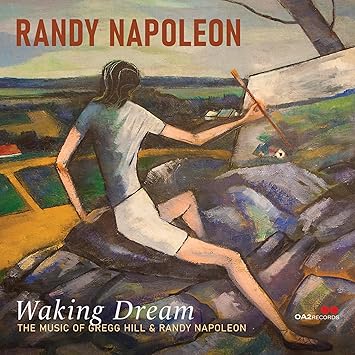
Randy Napoleon
Waking Dream: The Music of Gregg Hill & Randy Napoleon
OA2
OA2 22241
Celebrations of the music of jazz composer Gregg Hill continue to come out at a steady clip, and continue to demonstrate what a remarkable talent he is. Pianist Rick Roe’s Hill program opens with the strutting “Inside Straight,” then proceeds to a swaying 6/8 with “Sunspiration.” A particularly interesting juxtaposition is that between the lyrically straightforward “The Return of Mr. Pea” and the knotty “Modal Yodel #2” that immediately follows. Roe’s arrangements for saxophone and piano trio are sharp and insightful, as are his solos. Roe also appears on Randy Napoleon’s album, which features no fewer than five guitarists and a whole passel of guest instrumentalists in addition to a rhythm section consisting of Roe, bassist Rodney Whitaker, and drummer Quincy Davis. Napoleon has taken on a pretty monumental challenge of arrangement here, and meets that challenge admirably. From the first track (“Silver Moon”) you hear how wisely Napoleon marshals the forces of these guitarists, writing tight harmony lines for some while others comp in rhythmic unison behind; he takes a similar approach on the tango-inflected “The Speckled Frog,” though here the harmonies are even denser and the comping patterns more complex. This is an unusually complex but also accessible and deeply rewarding album. Both are recommended to all jazz collections.
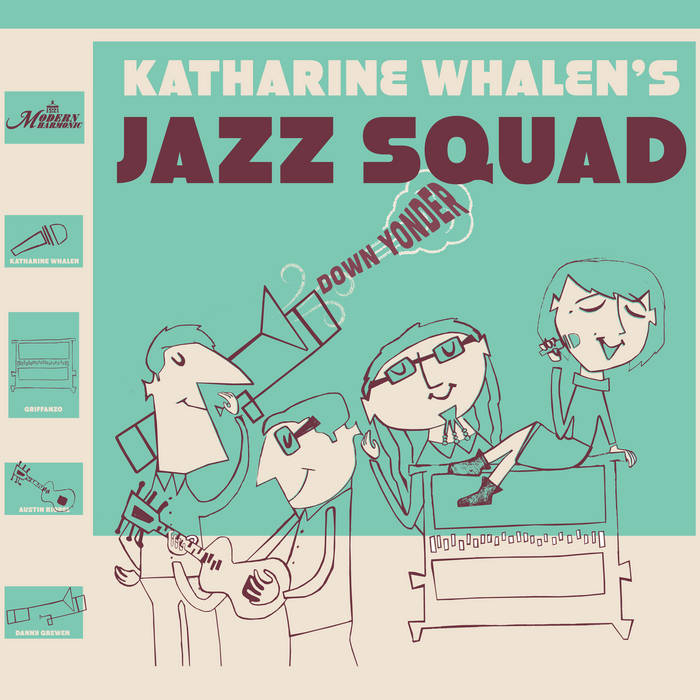
Katharine Whalen’s Jazz Squad
Down Yonder (digital only)
Sundazed Music (dist. Redeye)
No cat. no.
Ever since her time with the Squirrel Nut Zippers, Katharine Whalen has been a unique force in jazz singing precisely by bringing back what was, 100 years ago, a very popular female singing style: slightly nasal, vibrato-laden, simultaneously girly and vampy. (Imagine someone singing “I Wanna Be Loved by You” and you’ll immediately hear in your mind the style I’m talking about.) After leaving the Zippers in 1999 she recorded a solo album at the head of Katharine Whalen’s Jazz Squad, and then, after a 25-year hiatus, made a Chet Baker tribute album with the same group. Gratefully, her release tempo is clearly picking up, and her latest is both delightful and entirely unsurprising: a program of familiar American Songbook standards — we’re talking “Surrey with the Fringe on Top,” “My Heart Belongs to Daddy,” like that — performed in an explicitly pre-bebop style. Her voice has deepened and matured but her singing approach still harks way back to the 1920s. (One of her sidemen sings winningly on “I’m Gonna Lock My Heart,” but I don’t know who it is; information about the album beyond the tracklist is tough to find.) Down Yonder is a warm, embracing pleasure to listen to.
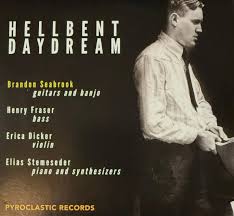
Brandon Seabrook
Hellbent Daydream
Pyroclastic
PR 45
We’ll call this one jazz, though (as anyone familiar with the work of guitarist/banjoist/composer Brandon Seabrook will expect) it tramples gleefully over virtually all established genre boundaries. His quartet on this album consists of himself, bassist Henry Fraser, violinist Erica Dicker, and pianist/synthesist Elias Stemeseder, and the music is all over the place — in a good way. “I’m a Nightmare and You Know It” is tightly composed but weirdly chaotic-sounding, a bit like vintage Henry Cow. “Bespattered Bygones” combines clawhammer banjo with fiddle in service to a tune that is simultaneously old-timey and not quite fully tonal. (“The Arkansas Tattler,” similarly but differently, sounds like a jam session between J.D. Crowe and Anton Webern.) “Existential Banger Infinite Ceiling” is quiet, but not settled; there’s an almost Schoenbergian, Verklärte Nacht vibe to its oddly floating harmonies and eerie Romanticism. If none of this sounds exactly like praise, then that’s just me being clumsy: Seabrook is a genius and this music is both fascinating and engaging. It’s just not going to be like anything you’ve heard before from anyone except Seabrook. And how can that be anything but praise?
FOLK/COUNTRY
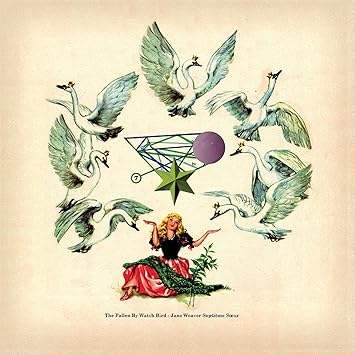
Jane Weaver
The Fallen by Watch Bird (Expanded Edition)
Fire (dist. Redeye)
FIRE796
Jane Weaver characterizes the music on The Fallen by Watch Bird as “psych-folk,” which is pretty apt, I think. Certainly the first few tracks of the original album conjure up something of a gentle acid trip: the slightly creepy spoken-word “Europium Alluminate” and “A Circle and a Star” open the program before segueing into the atmospheric doom-pop of the title track; elsewhere you’ll find a witchy Welsh song (“Hud a Llefrith” [“Magic and Milk”]), a Fairport-evoking slice of mostly acoustic folk-rock (“Whispers of Winter”), and the deeply eerie “My Soul Was Lost, My Soul Was Lost, and No One Saved Me.” This album was originally released 15 years ago, and this new expanded reissue appends another full album’s worth of collaborations and cover versions of the original songs featuring artists like Emma Trica, Wendy Flower, and Demdike Stare. Some of these are even weirder and creepier than the original versions — and I mean that in the best way. Recommended to all adventurous library collections.
The Foreign Landers
Made to Wonder
Tin Foil Studio
TFS003
Every once in a while, I get an album for review consideration that completely takes me by surprise, knocking me over with its qualities in virtually every dimension. This is one of those. It’s hard to know where to start in enumerating its virtues: the songs are complex but instantly accessible; the singing is simply superb, the harmonies unfailingly tight and sweet; the instrumental skill in evidence is jaw-dropping — Tabitha Agnew Benedict is a brilliant banjo player in both Scruggs and clawhammer styles, as well as a very fine guitarist, and her husband David Benedict is not a lick behind her as a mandolinist. Apart from a lovely arrangement of the traditional “I Am a Youth Inclined to Ramble” (featuring a gorgeous whistle performance by Flook’s Brian Finnegan) the program is entirely original, and the songs reflect on friendship, longing, religious conversion, and the evanescence of beauty. It’s literally impossible to identify a highlight on this album — every track is magnificent. Honestly, I’m kind of in awe.

kissing other ppl
kissing other ppl (vinyl & digital only)
Peacedale
No cat. no.
Kissing other ppl is something of a low-key indie-folk supergroup: it consists of Vivian Leva, Riley Calcagno, and Rachel Baiman, all of whom have made their names elsewhere. Leva and Calcagno perform as Viv & Riley (I recommended their album Imaginary People a couple of years ago), while Rachel Baiman is a solo artist who has worked with the likes of Molly Tuttle and Kacey Musgraves. Together, the three of them have created a moody, evocative trip through contemporary folk sounds with an interesting twist: these are all cover songs, from a variety of genres. Calcagno sounds a lot like James Taylor on his performance of Songs:Ohia’s “Hold on Magnolia,” while the trio takes Dr. Dog’s rollicking “Where’d All the Time Go?” and turns it into a meditation, with quiet clawhammer banjo and gently keening fiddle. Their take on Joan Armatrading’s “Woncha Come on Home” is similarly subdued, but still effectively conveys the original’s soulful intensity. This album is a really interesting experiment, and a successful one.
ROCK/POP
Obadiah Gamble
Notice
Self-released
No cat. no.
Looking at his photos and website, I’m trying to figure out how old this kid is, and my best guess would be… maybe 14? He apparently got his start as a singer/songwriter at age 6, when he wrote a song called “Hey Teddy” that resulted in Minnesota Vikings quarterback Teddy Bridgewater showing up at his birthday party. Anyway, here’s his first album, and it’s shockingly good. His high, clear voice and openhearted earnestness put me in mind of Bryce Avary, who released his first EP as The Rocket Summer at a similarly young age — but whereas Avary has always been a purveyor of high-energy pop and guitar rock, Obadiah Gamble works in a much more subdued dream-pop/indie-pop vein, with regular diversions into bossa nova (note in particular the brilliant “Eyes for You”). “Late Night Thoughts” and “Felt It” are both startlingly sophisticated pieces of dream-pop, and honestly, “startlingly sophisticated” would be a good descriptor for just about everything here. Keep an eye on this kid.
Buzzcocks
Attitude Adjustment
Cherry Red (dist. MVD)
CDBRED931
Who would have thought that in 2026 I’d be reviewing a new Buzzcocks record? Not me. 50 years after their founding and eight years after the death of singer/bandleader Pete Shelley, I would have fully expected that they’d be ready to hang it up — but apparently not, and good on them. Original member Steve Diggle has stepped up as full-time singer and guitarist, and I have to say that these septagenarians sound as good as — if not better than — any 30-year-old upstart punk rockers on the scene today. One thing that has always set the Buzzcocks apart is their ability to wield sophistication and make it sound simple: check out “My Poetic Machine Gun,” for example, and keep track of the song’s structure; it’s not nearly as straightforward as it sounds at first. “Tears of a Golden Girl,” on the other hand, is just as simple as it sounds, and more power to it. I also loved the subtle dubwise flourishes on “Heavy Streets.” This one’s all killer, no filler.
Nondi_
Nondi… (vinyl & digital only)
Planet Mu (dist. Redeye)
ZIQ481
Forward-thinking dance music artist Nondi describes the music on her second self-titled album as “meant to be cute, fun, kinda weird and emotional — but most of all, it’s a presentation of some of the prettiest tracks I’ve made.” Newcomers to her work might find that characterization a little bit puzzling: “Tree Festival,” for example, is dense and bustling and just a bit spiky, with cloudy pads that get elbowed aside by a stutter-step beat and layers of lo-fi keyboards, while “I Version Melody” is downright disorienting — a juddering, claustrophobic agglomeration of tones and samples, its rhythm conveyed almost entirely by the entry and departure of small chunks of sound. But listen closer: there really is quite a bit of prettiness here, in the subtle details of color and melody and the joyful crashing-together of disparate elements. Nondi is definitely a young artist to watch.

Mercyland
Mercyland
Propeller Sound Recordings (dist. Redeye)
CD-PSR-031
This one has been sitting on my desk for a while as I’ve kind of looked askance at the cover photo and thought “Eh, that doesn’t really look like my kind of thing.” But then I noticed that the one-sheet said “For fans of Sugar, Bob Mould, Hüsker Dü, the Replacements, Mission of Burma…” and I thought “Dang, that actually does sound like my kind of thing.” And what do you know? It absolutely is. Mercyland came on the scene in 1985 and had burned out by 1991, but in the meantime they made the kind of razor-sharp punk rock that I’ve never stopped loving: loud, tight but rough-edged, kind of snotty, sneakily tuneful. Bassist and singer David Barbe would go on to play with Sugar, and you can definitely hear that Hüsker Dü influence on songs like “Ciderhead” and (especially) “Imperial Vision.” These are eight-track recordings that were only released on a limited basis while the band was in operation, and it’s great to see them coming back to market now.
The Cords
The Cords
Slumberland
SLR 296
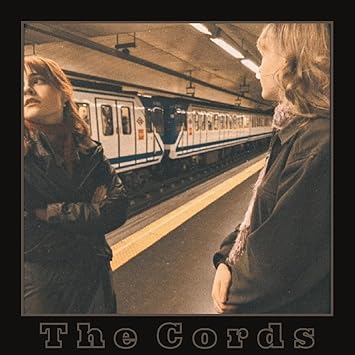
The Cords, a Scottish sister duo, make music in a pop subgenre called “C86” — named for a cassette compilation released by the NME in 1986. The aesthetic is scrappy, rough-hewn, but still hooky, and on their debut album the Cords offer a short, sharp blast of that vibe. The songs are high-energy jangle-pop that immediately evokes the Sundays and a less razor-edged Primitives. But structurally, their approach brings to mind the Ramones: all high-energy, no ballads, hardly any harmonies, no guitar solos, just energetic strumming, unison singing and brief, tightly-structured songs, one with a “ba-ba-baba-baaaa” chorus. “Yes, It’s True” drifts into punk territory, but with a dreamy chorus floating above the distorted guitars. There actually is one ballad, the album-closing “When You Said Goodbye” — though on any other album it might feel more midtempo. Coming at the end of this thirteen-track, 30-minute rush of high-velocity pop songs, it feels more like a waltz. Can’t wait to hear what comes next from this duo.
WORLD/ETHNIC
Ashtech
Walkin’ Target (expanded reissue, vinyl & digital only)
Dubmission (dist. MVD)
CDDUBM155
One of the problems with vinyl as a recording medium is that it constricts the dynamic range of your music: in other words, the greater the difference between the quietest and the loudest parts of your music, the more space you have to put between the record grooves and the less music you can encode in the vinyl. (Another little-known fact is that if the bass is recorded too loud it can actually make the needle jump out of the groove.) I mention this by way of explaining that when this collaboration by bassist Ashtech and producer Gaudi was originally issued in 2007 on the late and lamented Interchill label, several tracks had to be left off of the vinyl edition in order to maintain sound fidelity. Now comes a digital reissue that restores all the original material. And that material is great: Ashtech is a very fine bassist with both a deep understanding of reggae principles and the ability to incorporate them into more forward-thinking electronica structures; on tracks like “Sun Shines on You” and (especially) “Earthforce,” he wields simplicity with elegance. And Gaudi’s advanced dub production techniques bathe everything in a warm glow.
Murmurosi
Svitanok
Self-released
No cat. no.
There’s a special kind of intensity to the various folk music traditions of Eastern Europe: the astringent harmonies, the headlong tempos, the horns, the drums. In the folk music of Ukraine, you hear elements of both Baltic and Balkan traditions, but there’s something unique there as well. And given current circumstances, there is perhaps an added intensity to the music created by a band like Ukrainian-Canadian ensemble Murmurosi. On Svitanok, they explore themes of family separation and destruction, along with the more pastoral themes that characterize so much traditional music from the region. The singing on this album is particularly compelling, but there are also lots of inventive instrumental arrangements and virtuoso playing. Recommended to all world-music collections.
Toni Geitani
Wahj (digital & cassette only)
Self-released
No cat. no.
Tonu Geitani was born in Lebanon but is now based in Amsterdam, where he not only produces music but is also involved with sound design and filmmaking. That breadth of interests and skills won’t be surprising to anyone who listens to Wahj, a sprawling collection of sonic experiments that draws on vocal traditions of maqam and layali, but pulls in elements of industrial electronica, dark ambient, and electro-pop as well. Imagine a Rapoon album remixed for release on the Ohm Resistance label, or what might happen if Bill Laswell were given free rein with a Muslimgauze cassette. Every track is different, from the vocoder-inflected “Tuyoor” to the sonically confrontational “ta’Xud II” and the eerily sample-based “Wasla.” As a lover of both Arabic classical music and experimental electronica, I found this album endlessly intriguing, if not always easy listening.
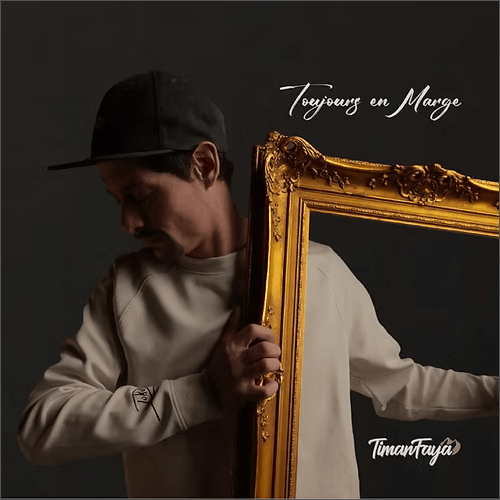
TimanFaya
Toujours en marge
Oxalis
No cat. no.
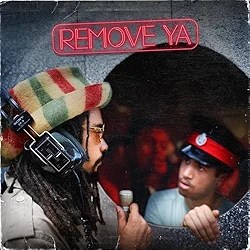
Solijah
Remove Ya (EP, digital only)
Remove Ya Productions
No cat. no.
Let’s close out this month’s issue with a pair of fine new European reggae releases, both by French-speaking artists: the Swiss-born Timanfaya and the Rouen-based Solijah. Timanfaya’s album, at 27 minutes, is all too brief: he and his band deliver the modern-roots goods with eight tracks of heavyweight beats, tight harmonies, great melodic hooks, and positive lyrical messages, from “Il Faut q’on ose” (“You must take chances”) to “J’Attendrai pas” (“I won’t wait”). Solijah’s EP is also way too short (though at least it’s bering marketed as an EP), offering a program of old-school roots-and-culture reggae tracks inspired by the classic 1978 reggae documentary Rockers. The cover art is an explicit tribute to that film, as is its title; the program also includes, apparently as a hidden track, a faithful rendition of Jacob Miller’s deathless hit “Tenement Yard.” Solijah’s songs are exhortations to bring about a new world and elevate ourselves spiritually, all buttressed by solid rockers and rub-a-dub rhythms. Both releases are highly recommended.
 CD HotList