CLASSICAL

Jean-Marie Leclair
Violin Concertos, Vol. 1
London Handel Players / Adrian Butterfield
SOMM (dist. Naxos)
SOMMCD0711
Jean-Marie Leclair had the misfortune of being a violin virtuoso at a time and in a place (mid-18th-century France) when the violin was looked upon condescendingly by high society, which considered the viola da gamba to be the proper instrument for cultivated chamber music and the violin suited mainly for playing country dances or filling space in an orchestra. But through both his virtuosic playing and a compositional approach that drew both structurally and stylistically on the highly popular Italian baroque style, Leclair managed to almost singlehandedly establish a new school of French violin playing. This set of four concerti, performed with sumptuous loveliness by the London Handel Players (led by soloist Adrian Butterfield) shows Leclair at his best, constructing works with an eye simultaneously on the innovations of Bach and on the hugely influential works of Corelli and Vivaldi. Few libraries will have significant holdings in Leclair’s work, so this release will be of particular interest.
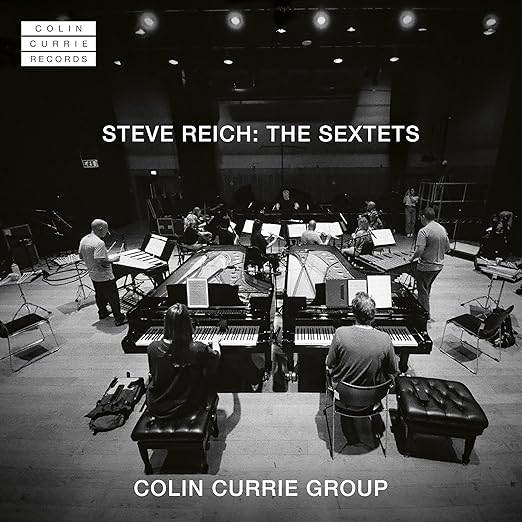
Steve Reich
The Sextets
Colin Currie Group
Colin Currie (dist. Integral)
CCR0009
If you look back at early (i.e. 1960s) minimalism, you’ll see that there were basically three schools, each with a primary exponent: mystical drone (Terry Riley), phased repetition (Steve Reich), and relentless arpeggiation (Philip Glass). To my ears, Reich was always the most interesting of these three pioneers; while his work tended to be relatively harmonically static, it was so constantly changing and consistently interesting in texture and rhythm that it never seemed dull or even truly repetitive. The four works for percussion sextet presented on this album were written at various stages of his long career: Sextet (1984), Double Sextet (2007), Six Marimbas (a 1986 arrangement of Six Pianos from 1973), and Dance Patterns (2002). All of them find Reich developing his unique approach to maximal sonic variety within a context of minimal harmonic change; downbeats shift, patterns spin and change kaleidoscopically; struck notes bounce off of shimmering sheets of bowed vibraphone tones, etc. Percussionist Colin Currie and his ensemble have emerged over the past two decades as the premier interpreters of Reich’s music, and this album is well up to the high standard they’ve set so far.
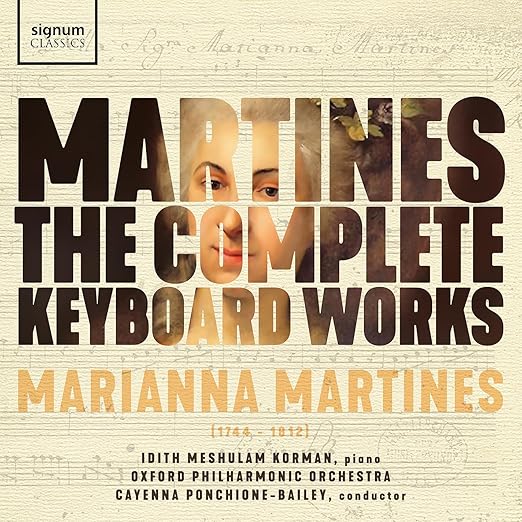
Marianna Martines
The Complete Keyboard Works (2 discs)
Idith Meshulam Korman; Oxford Philharmonic Orchestra / Cayenna Ponchione-Bailey
Signum Classics (dist. Naxos)
SIGCD934
If musical history weren’t so rife with outstanding composers who were influential and widely admired in their day, but who have been largely forgotten today, Marianna Martines’ story would seem odd: in Vienna during the high classical period she was a major figure, known both as a keyboard virtuoso and a gifted composer, yet her work has been recorded only rarely (in part, perhaps, because not much of it has survived; most is sacred choral music). This two-disc package brings together all of her known compositions for keyboard: four concertos, three sonatas, and a sinfonia for keyboard and orchestra. Playing on modern instruments, the Oxford Philharmonic Orchestra and soloist Idith Meshulam Korman present these lovely works in a warm, inviting acoustic, and do so with palpable delight in the music. Listeners will notice similarities to both the young Mozart and to C.P.E. Bach at times. For both its historical significance and its pure musical quality, this release should find a welcome place in any academic collection.
Ignatius Sancho et al.
Music of an Eighteenth-century Black Englishman
Sonya Headlam; The Raritan Players / Rebecca Cypress
Centaur (dist. Naxos)
CRC 4156
While the music of women composers of the 18th century is relatively rarely attested in modern performances and recordings, that of black composers from the period is much rarer still. Ignatius Sancho worked, in apparent enslavement (or at least servitude), as a child before running away and joining the house of the Duke of Montagu, where he learned to read and write. He eventually became a shopkeeper, playwright, author, and composer. His music is not often recorded today; this album includes several dozen of his songs and dance tunes alongside works by a few of his contemporaries including Thomas Arne and Jonathan Battishill. The Raritan Players, using period instruments, utilize an unusual square piano appropriate to the period, and the writing for French horn is particularly noteworthy given the significance of that instrument for black culture in that time and place. Recommended to all classical collections.
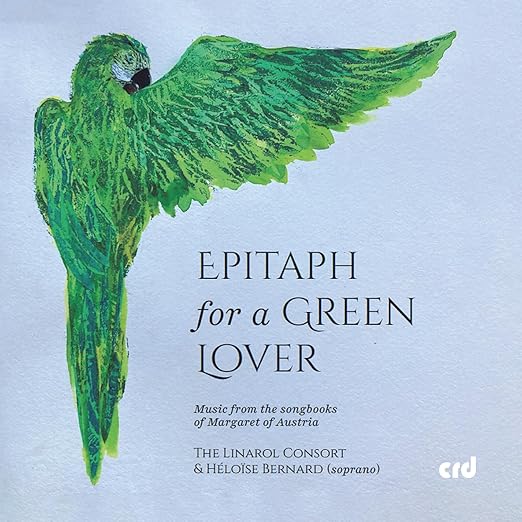
Various Composers
Epitaph for a Green Lover: Music from the Songbooks of Margaret of Austria
The Linarol Consort; Héloïse Bernard
CRD (dist. Naxos)
CRD3561
This intriguingly titled album consists of songs taken from two collections owned by Margaret of Austria, Duchess of Savoy, Governor of the Hapsburg Netherlands (1480-1530). The program is centered on a chanson written for her by her court poet, Jean Lemaire de Belges, in honor of her beloved green parrot. Other composers featured in this program — which consists entirely of previously unrecorded pieces — include Franco-Flemish luminaries Pierre de la Rue, Josquin des Prez, Jacob Obrecht, and Antoine Brumel. Some of the music consists of instrumental performances of polyphonic chansons (played exquisitely by the Linarol viol consort on reproductions of 16th-century instruments), while on other tracks the group accompanies the singing of Héloïse Bernard, a soprano whose astonishingly lovely voice manages to be both luminous and dark-hued. It would be hard to overstate both the charm and the mystery of this music, which partakes of the unique melodic strangeness of the late medieval/early Renaissance period; any library with a collecting interest in early music should jump at the chance to add this disc to its collection.
JAZZ
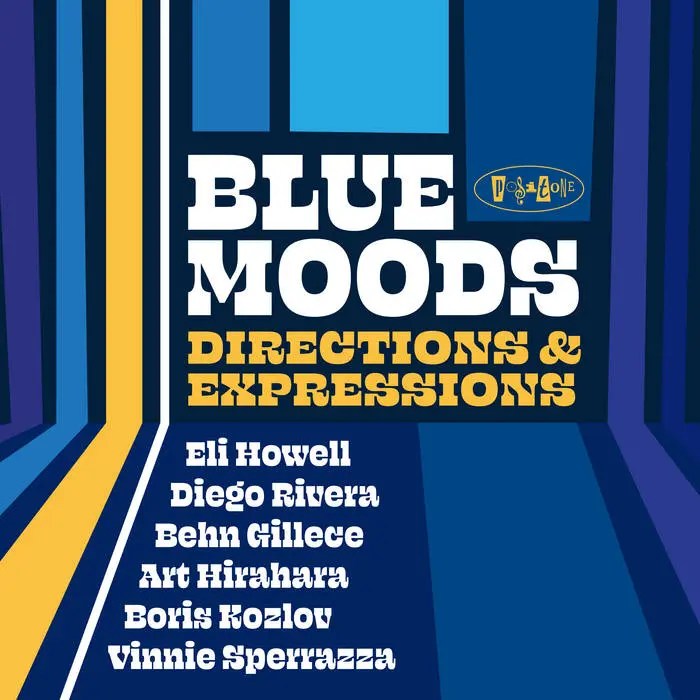
Blue Moods
Directions & Expressions
Posi-Tone
PR8274
Blue Moods is a jazz supergroup consisting of saxophonist Diego Rivera, trombonist Eli Howell, the magnificent vibraphonist Behn Gillece, pianist Art Hirahara, bassist Boris Koslov, and drummer Vinnie Sperrazza — basically, the purebred racehorses of the Posi-Tone stable. In what seems to be turning into an annual tradition (this is the group’s fourth album in as many years), they’re back with another all-Miles Davis program, playing tunes that range from his early years when he was ushering in the “Cool” school (“Boplicity,” “Half Nelson”) to his more adventurous 1960s material (“La Suite de Kilimanjaro,” “Circle”) clear up to the early 1980s (“U’n’I,” from his 1982 jazz-funk excursion Star People). As always, the Blue Moods crew is deeply respectful — they wouldn’t be making these albums if they didn’t revere Miles — but also fully willing to make the tunes their own. For example, the scratchy electric funk of the original “U’n’I” is transformed here into an almost New Orleans-style swing shuffle. The playing is warm and engaging, and every musician shines. Highly recommended to all jazz collections.
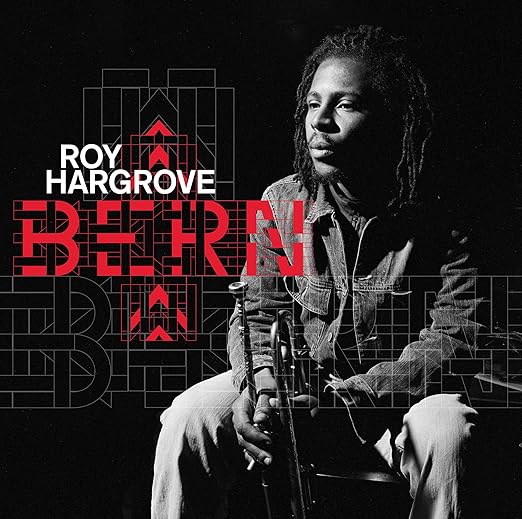
Roy Hargrove
Bern
Time Traveller
TT-C003
Trumpeter/composer Roy Hargrove left us far too soon, dying of kidney failure at the tragically young age of 49. He left a rich legacy of studio recordings, but also of live ones, some of which are now coming to light for the first time. This disc documents his performance at the International Jazzfestival in Bern, Switzerland, in May of 2000. He was leading a quintet that featured saxophonist Sherman Irby, pianist Larry Willis, bassist Gerald Cannon, and drummer Willie Jones III. He was 30 years old at the time, about 13 years into what was already an illustrious career, and he and his ensemble play like they’ve got something to prove. The set-opening Steve Lacy composition “Stranded” is thrilling, played at breakneck tempo but with an almost off-handed virtuosity — Irby’s solo is particularly breathtaking. The band swings powerfully on Hargrove’s own “Depth” and nimbly negotiate the tricky rhythms of his “Caryisms,” and all through the set basically sound like they’re having the time of their lives. The sound quality is not exceptional, but quite good.
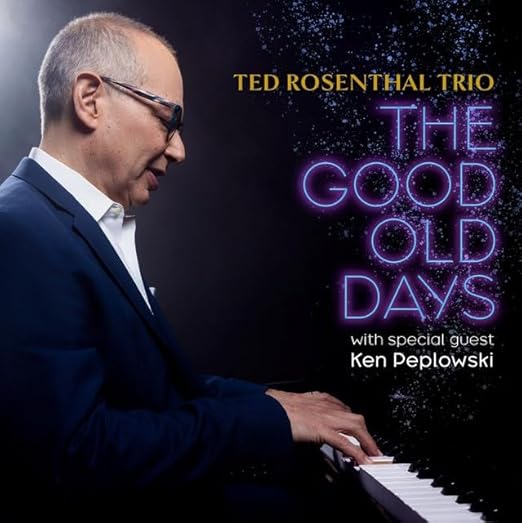
Ted Rosenthal Trio
The Good Old Days
TMR Music
TMR #022726
The Good Old Days is a perfectly apt title for the latest release from pianist and composer Ted Rosenthal. It offers a mix of familiar standards (“From This Moment On,” “Autumn in New York,” even “Maple Leaf Rag”) and originals, but everything is played in a style that evokes what many will consider the good old days of jazz: for example, on his own “Sultry Sweetie” Rosenthal lays out rich, orchestral chords that evoke the 1960s playing of Errol Garner and Oscar Peterson, whereas he brings a uniquely personal flavor to his interpretation of Scott Joplin’s classic rag and incorporates a sly quote from “Stompin’ at the Savoy” into the out chorus of his composition “The Good Old Days.” Clarinetist Ken Peplowski makes a welcome appearance on two tunes. Every track on this album is a pure pleasure, and it’s hard to imagine any fan of straight-ahead jazz not hitting <repeat> the moment it ends. For all library collections.
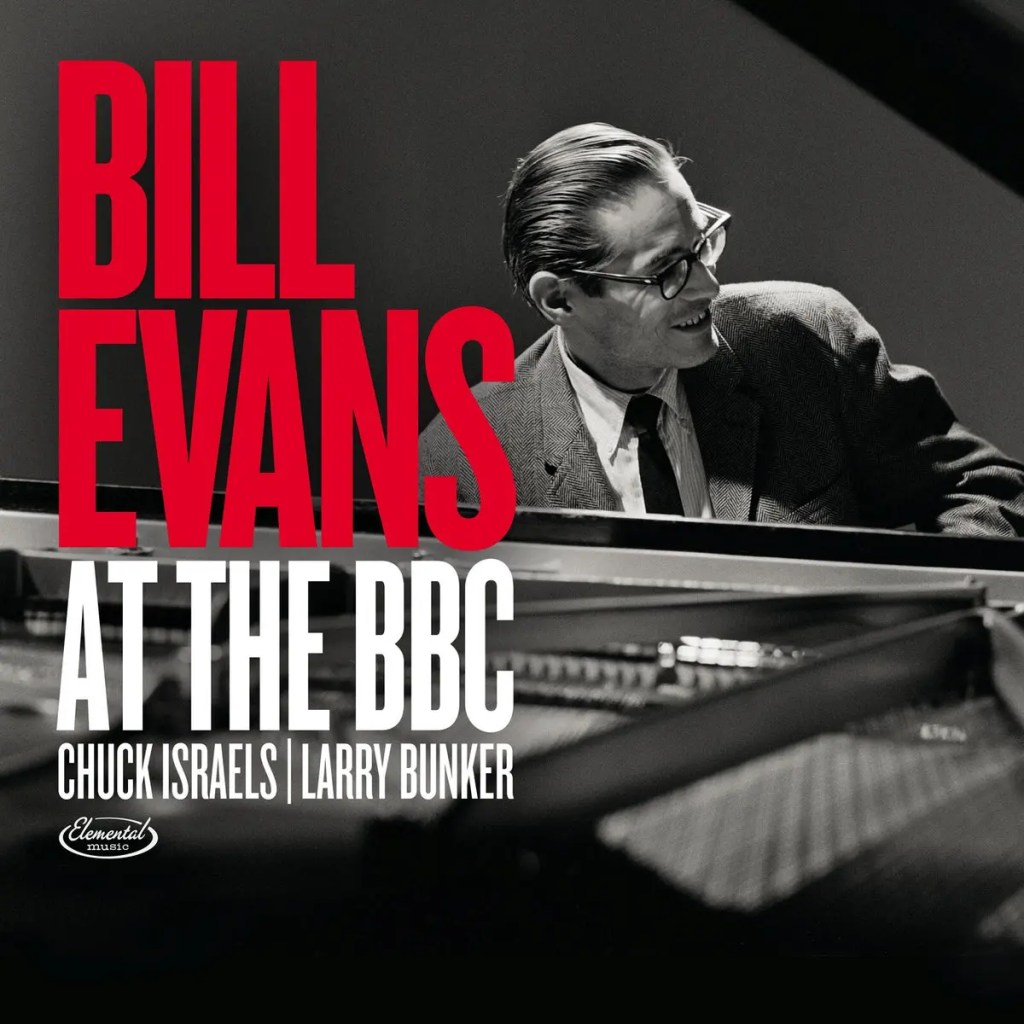
Bill Evans
At the BBC
Elemental Music
5990458
Producer and archive rat extraordinaire Zev Feldman continues to bring lost musical treasures to a grateful jazz world. The latest is this radio recording made in 1965 by the legendary Bill Evans, leading a magnificent trio that features the young Chuck Israels on bass and Larry Bunker on drums. The disc comprises two full programs of a BBC TV show called Jazz 625, both sessions recorded in front of a live audience on March 19 of that year. Each includes a two-minute intro and some interstitial commentary by the show’s host, neither of which feels strictly necessary, and the sound quality isn’t great — although there’s a surprisingly good balance between the instruments, the piano is noticeably distorted. But the playing is simply marvelous. This version of Evans’s trio had been playing together for several years by now, and they sound wonderfully comfortable with each other. The program includes most of the originals and standards that had become audience favorites by this point: “Waltz for Debbie,” “My Foolish Heart,” “How Deep Is the Ocean,” etc. Despite the marginal sound quality, no academic library’s jazz collection should pass this one up.
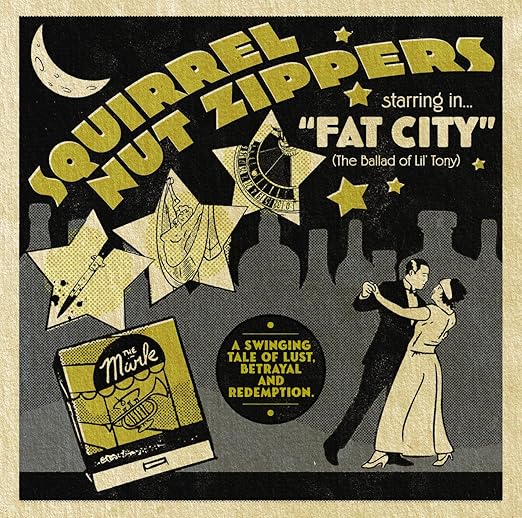
Squirrel Nut Zippers
Starring in “Fat City” (The Ballad of Little Tony)
Music Maker Foundation (dist. MVD)
MMCD231
Remember the Squirrel Nut Zippers? They came on the scene with perfect timing in the mid-1990s, at the beginning of an intense but brief swing-dancing craze, and their unique brand of oddball hot-jazz energy, combined with an unapologetically (and apparently unironically) retro sensibility really caught the attention of the music-buying public for a while. But when fashions changed, as they always do, that public moved on and the Zippers eventually disbanded. Now they’re back, in a new configuration that shares with the old one only the presence of founder Jimbo Mathus. This release is sort of a concept album, with 23 songs presented in three “acts,” all centered around the theme of a city trying to reinvent itself. The music ranges from Tom Waits-ish music hall dissolution (“Il Campanile,” “Castaway Stones”) to Latin-ish midcentury pop (“Summerstorm”) and New Orleans jazz blues (“Don’t Doubt Me Babe”). As one might expect, it’s all lots of fun.
FOLK/COUNTRY
The Gated Community
Goodbye Work
Self-released
No cat. no.
Local stars on the Minneapolis folk/Americana circuit for a couple of decades now, The Gated Community self-released this album in mid-2025. The sound is pretty typical for this genre: mainly acoustic with understated percussion and a bit of electric (sometimes slide) guitar, a bit of harmonica, some piano. What is unusual is the quality of the songwriting, and the degree to which the group functions as an apparently egalitarian and fully-integrated whole. Lead vocal duties are shared around, and while the male vocals tend to be pleasant but plainspoken, when one of the band’s women takes the lead, they’re more noteworthy: the title track is sung particularly pleasingly, as is the lovely (and beautifully written) “What I Hate.” “All Wrong” is gorgeous and heartbreaking; “Weed Smoke and Worry” has a bit of a honky-tonk feel, nicely leavened by Rosie Harris’s banjo. The album’s best opening line comes from “Petty”: “There’s choppers enforcing a curfew.” Recommended.
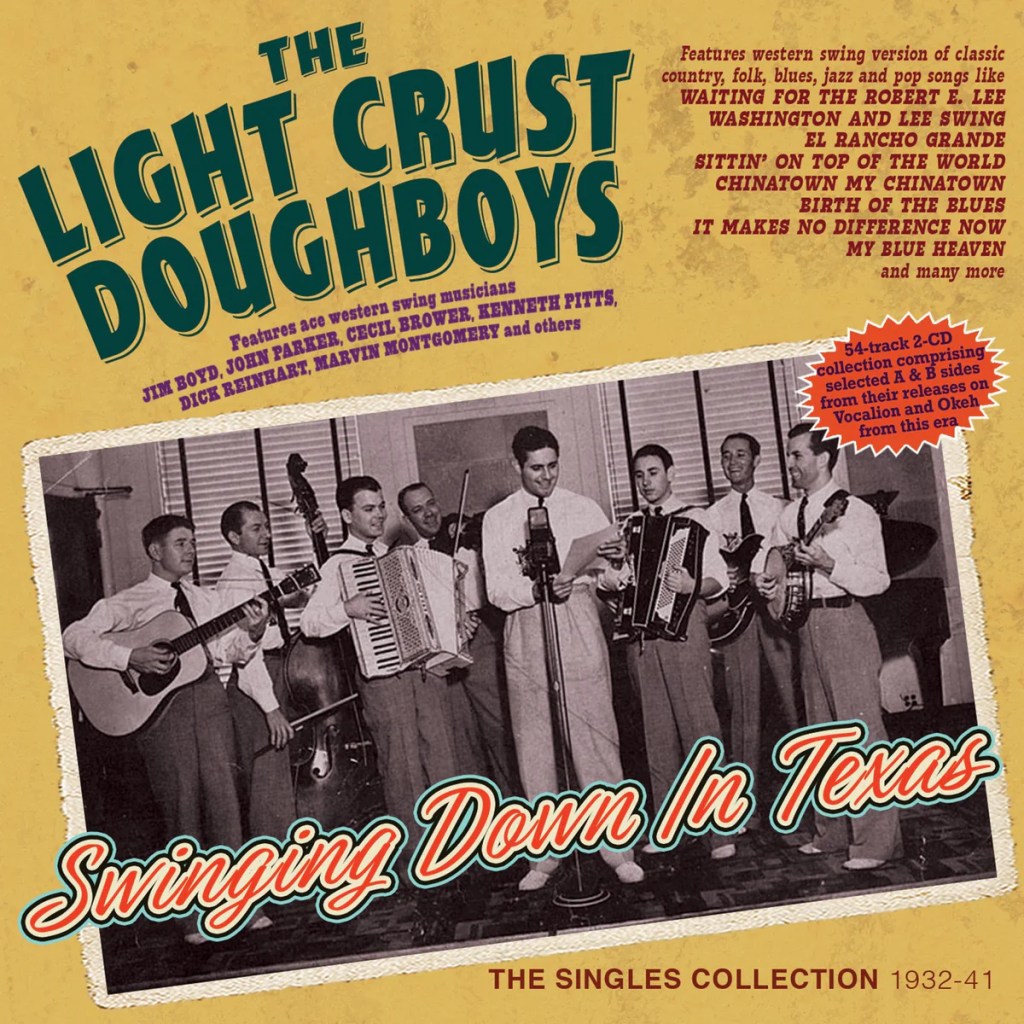
Light Crust Doughboys
Swinging Down in Texas (2 discs)
Acrobat (dist. MVD)
ADDDCD3587
Bob Wills and His Texas Playboys have become so comprehensively the poster boys of Western swing that it can be easy to forget that Wills neither solely invented the genre nor was its only prominent exponent as it developed in Texas in the 1930s. The Light Crust Doughboys were actually founded jointly by Wills and Milton Brown; when Wills broke off to form his own band Brown continued leading the Doughboys, who persisted as a performing group (with shifting personnel, obviously) into the 21st century. This generously packed two-disc set collects 78-rpm singles released by the band between 1933 and 1942, and showcases what set them apart from the Texas Playboys and others: a smoother and more pop-oriented sound. Unfortunately, some of the transfers are marred by skips and possibly digital anomalies that should have been caught and resolved during mastering. Still, both the recordings themselves and the extensive liner notes will be of great interest to libraries with a collecting interest in this genre.
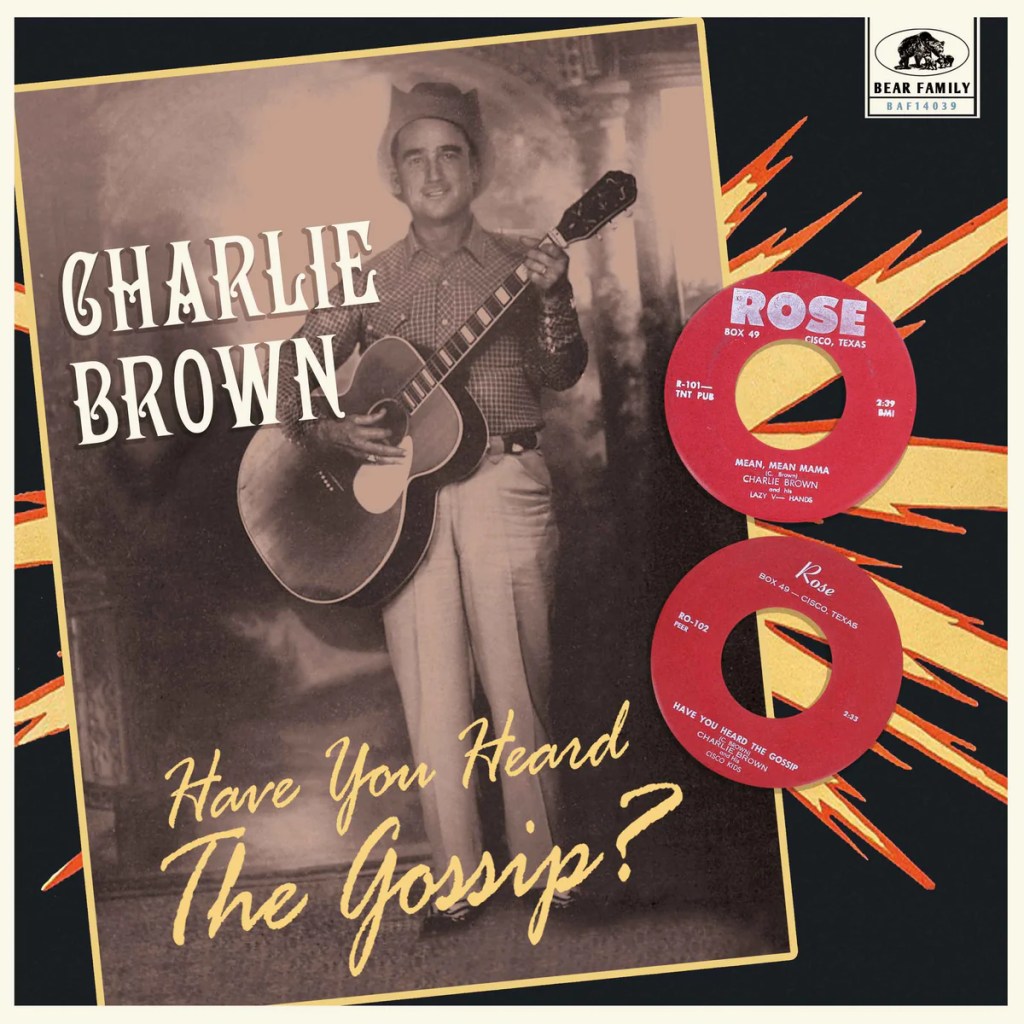
Charlie Brown
Have You Heard the Gossip? (vinyl only)
Bear Family (dist. MVD)
BAF14039
It seems like every time I review a Bear Family release I feel compelled to point out how shameful it is that a German label is doing so much better a job of lovingly archiving America’s folk, country, and (especially) rockabilly patrimony than any American label is. Anyway, thank heaven they’re doing it. The latest example of the label’s very fine work is this charmingly retro (on 10-inch, 45-rpm vinyl, no less) package of ten tracks by the little-known Texas honky-tonker Charlie Brown, whose mid-1950s singles helped to define the sound of early rockabilly. On these tracks you’ll hear the transition taking place — he’s influenced by Hank Williams but taking that vibe in a rawer, more stripped-down direction. The sound quality is not always great, but these recordings are at least as important as historical artifacts as they are as a fun listening experience. Which they also are. If your library supports the study of American vernacular music generally and country in particular, this is an essential release.
ROCK/POP

Flyboys
The Complete Flyboys 1978-1980
Frontier
31095-2
Nothing like a little old-school punk rock to clear the sinuses on a spring day. Flyboys had a brief and not especially illustrious career — over the course of a frenetic couple of years, they played a lot of opening sets around Southern California, and they recorded an EP and a follow-up single before breaking up. Part of the problem may be that they occupied a weird sort of middle ground both aesthetically (dressing like glam rockers but playing like punks) and musically (one high-heeled boot in power pop, the other in hardcore). Putting all of their released songs and five unreleased demos together results in an album barely half an hour long — but it’s a very, very fun half hour, and a pretty exhausting one. The liner notes and photos are a hoot.

Makthaverskan
Glass and Bones
Welfare Sounds & Records (dist. Redeye)
WSR190
The album cover and the band-name typeface might lead you to expect Scandinavian death metal. (Though to be fair, if it were Scandinavian death metal, the album title would be more like Glass Excreta of Infernal Fetus Bone Putrefaction.) But no — what Makthaverskan offer on their fifth album is much more interesting and much more fun. It’s sort of a jangle-dream-postpunk-pop fusion that sounds to me like what you might expect from a joint effort by the Sundays, Cocteau Twins, and Sonic Youth. Maja Milner’s voice takes the wild flexibility of Björk and constrains it with the melodic grace of Harriet Wheeler; Per Svensson’s and Hugo Randulv’s guitars create layers that are simultaneously dense and delicate, messy and tightly crafted. Like Elizabeth Fraser, Milner sings in such a way that she’s almost completely unintelligible — but that just brings out the beauty of her melodies more clearly. Highly recommended to all adventurous pop collections.
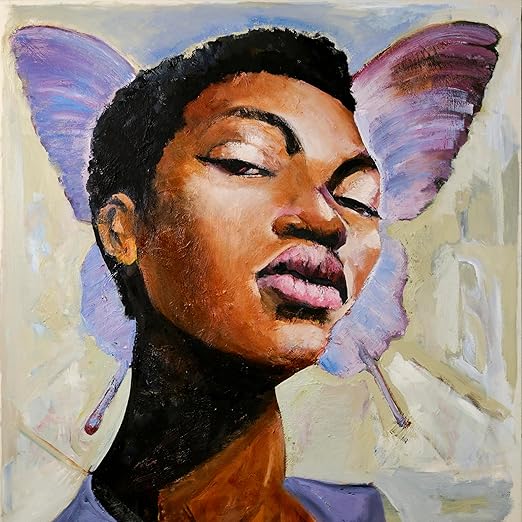
Brooklyn Funk Essentials
Black Butterfly (vinyl & digital only)
Dorado
DOR170LP
Old-school funk is not dead yet — nor is it likely to die, as long as there exist booties that want to shake. The eighth outing from Brooklyn Funk Essentials supports that goal most ably, the band delivering the rich and nimble horn lines, complex chicken-scratch rhythm guitars, and rubbery-but-solid drum parts that fans of venerable ensembles like Parliament Funkadelic and Tower of Power will remember with warm nostalgia. But this isn’t really a revivalist exercise; Brooklyn Funk Essentials bring their own ideas to the mix. For example: “Voodoo Gates” a 6/8 tune, which in the funk context is pretty unusual, but works nicely. The drum part on “Shameless” has a slippery, second-line quality to it, while their cover of Talking Heads’ “Life During Wartime” combines Latin and New Orleans elements with a nearly gospel vibe on the chorus. No pop collection should pass this one up.

Loraine James
Detached From the Rest of You
Hyperdub (dist. Redeye)
CD-HDB-074
There are many kinds of funkiness, of course. At the more avant-garde end of the scale is the Edgard-Varèse-in-the-club cut-up artistry of Loraine James, whose aggressively chopped and kaleidoscopically reconstituted songs feature both sung melodies and actual grooves, but render them frequently almost unrecognizable. Consider, for example, “A Long Distance Call,” which opens with a flurry of apparent chaos of glitches and warbles before resolving into a resolutely funky tune that prominently features heavily treated vocals. This track segues into “The Book of Self Doubt,” a showcase for her own voice, which is again heavily treated (she sounds distinctly male throughout) and laid gently over a bed of microscopic glitches and what sounds like a frog belching. I may not be making this album sound quite as intriguing as it is; let’s just say that any library supporting research in contemporary pop music or music production should consider it a must-own.
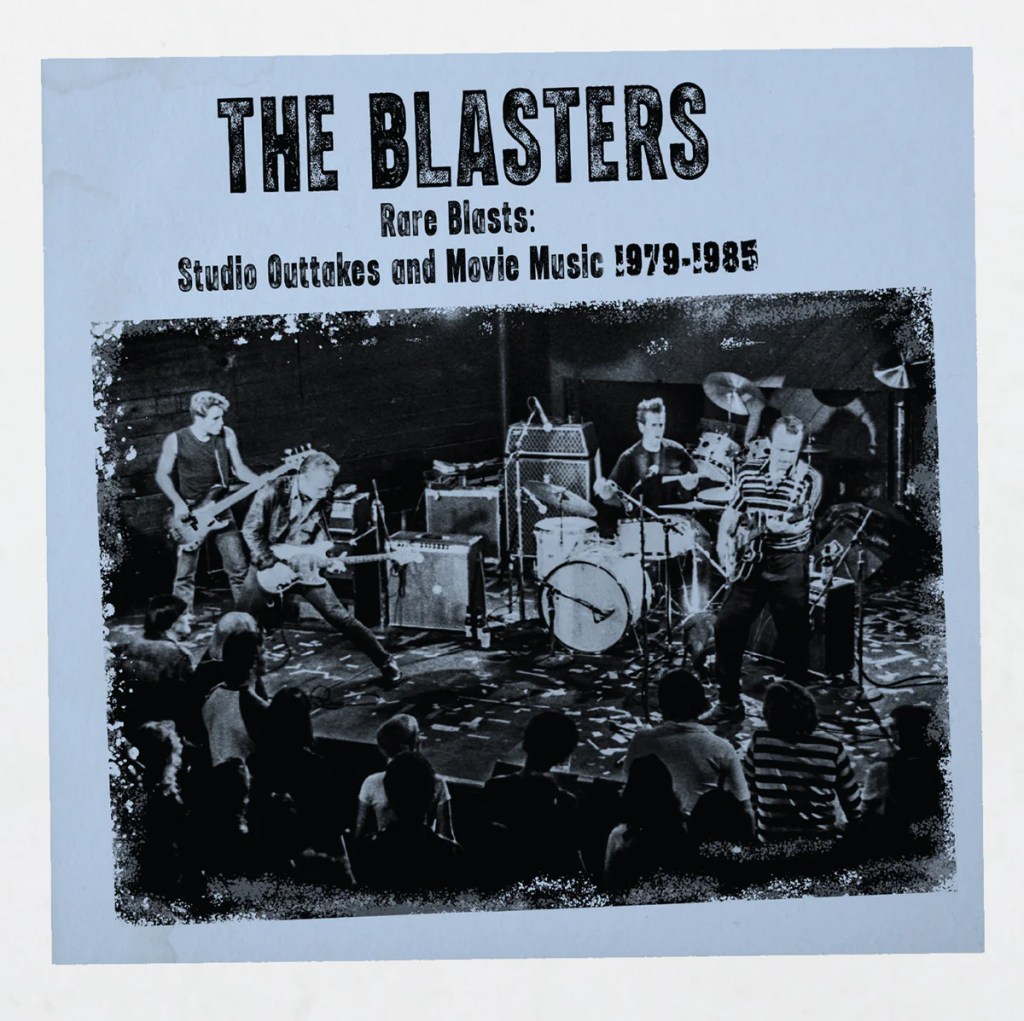
The Blasters
Rare Blasts: Studio Outtakes and Movie Music 1979-1985
Liberation Hall (dist. MVD)
LIB-2120
The Blasters were a real anomaly — they first achieved success on the Los Angeles punk circuit in the early 1980s, despite the fact that they were in no way a punk act. But their brash energy and unapologetic embrace of an archaic blend of early R&B, blues, and rockabilly marked them as rebels, and in early 1980s L.A. one form of rebellion was pretty much as welcome as any other. Of course, it helped that they had a world-class songwriter in Dave Alvin and one of the greatest voices in rock’n’roll in Dave’s brother Phil. The band’s official studio work has been fully documented by now, but this collection brings together a bunch of outtakes and a handful of tracks recorded for movie soundtracks that haven’t (for the most part) been included in previous compilations. (Some are different versions or takes of songs previously released, like “I Fell in Love” and “One Bad Stud.”) To listen to it is to be reminded again both of how much fire the Blasters generated during their heyday, and what a magnificent instrument Phil Alvin’s voice was.
WORLD/ETHNIC
Mativetsky Amiri Pagé
Metamorphose
Fifth House Music
FHM104
When a Western writer characterizes music of a Middle Eastern or South Asian character as “mysterious,” the specter of Orientalism is usually lurking. So let me be clear that when I say the music of Shawn Mativetsky, Amir Amiri, and Sarah Pagé sounds “mysterious,” I don’t mean it in the “Ooooh, that music makes me think of hookahs and harems” sense. I mean that Pagé’s harp, Amiri’s santur, and Mativetzky’s percussion combine to create music that floats and drifts and quietly cries out, expressing (and evoking) emotions that are hard to describe, or even nail down. In part, this is because the music itself contains both cultural multitudes and emotional contradictions: the program opens with “Yavaran,” a rhythmically knotty tune in 10/8 time that the trio plays with relaxed ease; “Quarter Tone Suite” sounds largely improvised, and features apparently synthesized whistle or flute tones in the background. Amiri’s Persian instrument and Mativestsky’s Indian tabla shouldn’t fit together, culturally speaking, but they do because cultural coherence isn’t the point here; delicious atmosphere is. Recommended.
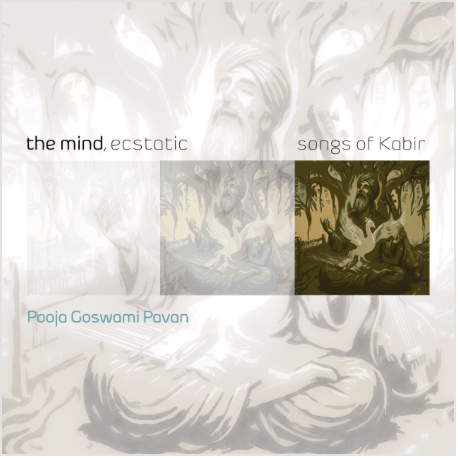
Pooja Goswami Pavan
The Mind, Ecstatic: Songs of Kabir
Neuma
261
I’ve been listening to this one on repeat — and given the number of promos I have to listen to in order to prepare a monthly issue of CD HotList, that should tell you something. The album itself is a collection of songs based on the poetry of Sant Kabir Das, a 15th-century Indian mystic, focusing on texts that explore the juxtaposition of apparent opposites: “I’m Terrified and I’m Laughing,” “In the Cave of the Sky,” etc. Five of the musical settings were created by singer Pooja Goswami Pavan and two by her father, while the arrangements (which primarily feature Indian instruments but subtly incorporate Western ones as well) were crafted by Ranjan Sharma. Pavan is a singer of exceptional gifts: her voice is as clear as a mountain stream and every bit as supple and sweet, and the music offers that uniquely Indian blend of advanced melodic complexity and emotional immediacy. Highly recommended to all collections.
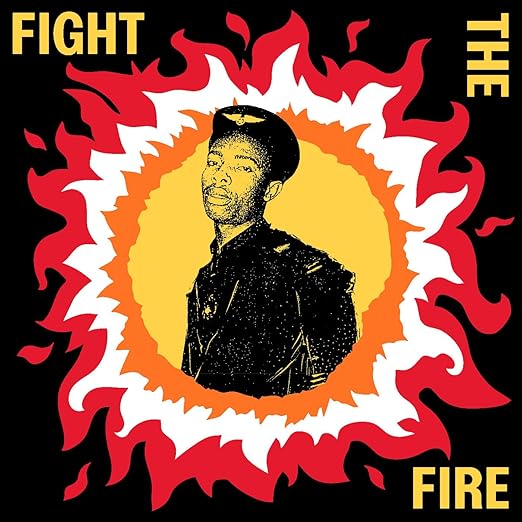
Various Artists
Fight the Fire: Digital Reggae, Conscious Roots and Dub in Nigeria 1986-91 (vinyl & digital only)
Soundway (dist. Redeye)
LPSNDW162
Given that so much of Rastafari philosophy is built around the primacy of Africa as spiritual homeland, it’s unsurprising that Africa has given rise to so many reggae scenes. What is surprising is how variable the quality of African reggae has been over the decades. For every world-class artist (Lucky Dube, Alpha Blondy, the brilliant Tiken Jah Fakoly) there’s been at least one mediocrity — but of course, the same could certainly be said of reggae artists from Jamaica and the UK. This collection focuses on artists from Nigeria, a country with an apparently deep and rich reggae scene. Not only does it feature quite a few little-known but quite impressive singers, toasters, and players (notably the very fine Orits Williki and Pat Bio, who owes royalties to Burning Spear but delivers a good performance on “Guide Us Jah”), but also the work of some gifted dub producers. A couple of tracks are curiously stiff-sounding, but overall this is both a musicologically interesting and very enjoyable compilation.
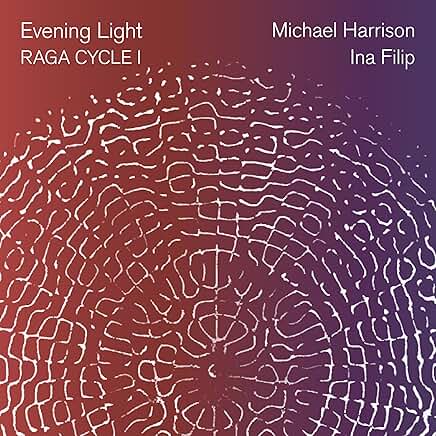
Michael Harrison and Ina Filip
Evening Light: Raga Cycle I (digital only)
Cantaloupe Music
No cat. no.
The thing about Indian ragas is that they don’t dictate instrumentation — a raga is basically a melodic phrase that can be sung or played on any instrument; the performer creates musical interest by improvising variations and elaborations on the melody. However, the practice of interpreting ragas in Indian classical music (whether Carnatic or Hindustani) tends to rely heavily on the ability to create microtonal variations, which means that you don’t hear a lot of Indian classical music played on the piano (though the hammered dulcimer and the harmonium are sometimes used). This album is the first in a projected eight-volume series that will find pianist Michael Harrison collaborating with other musicians on raga arrangements that follow a traditional time cycle that assigns certain ragas to certain hours of the day or night. Here he’s working with singer Ina Filip, synthesists/sound designers Elliot Cole and Benoit Rolland, and tabla player Mir Naqibul Islam, and the result is both sonically quite unique and deeply enjoyable — the piano never sounds like an Indian instrument, of course, but the organizational structure of the ragas and the vocal and percussion elements bring the Indian influence into the mix in a highly unusual way.

