CLASSICAL
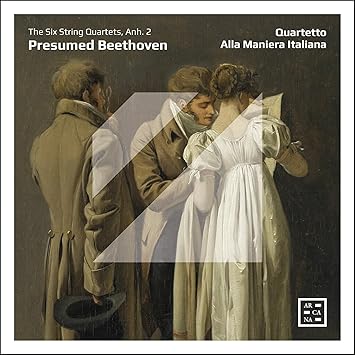
Ludwig Van Beethoven?
Presumed Beethoven: The Six String Quartets Anh. 2 (2 discs)
Quartetta alla Maniera Italiana
Arcana (dist. Naxos)
A591
For over 100 years, scholars have been trying to establish who wrote these six unpublished string quartets, which exist only in handwritten parts archived in the Berlin State Library. Originally they were attributed (though always tentatively) to Mozart; today the still-tenuous majority view seems to be that they are a product of Beethoven’s early career and written in homage to Mozart. The stylistic conventions of the classical era were so strong, however, that most of the obvious musical characteristics of these pieces mark them as possibly compositions of Haydn or even (as one scholar has suggested) Vanhal. The members of the outstanding period-instrument ensemble Quartetta alla Maniera Italiana made this world-premiere recording in the hope of inspiring renewed research on the question — but those who simply love the music of the high classical period will welcome it for the pure listening pleasure it affords. Strongly recommended to all classical collections.
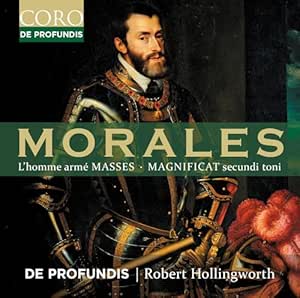
Cristóbal de Morales
L’Homme armé Masses; Magnificat secundi toni
De Profundis / Robert Hollingworth
CORO (dist. Naxos)
COR16221
We all know the common story of the Renaissance or baroque composer who, though successful and highly regarded in his or her name, had fallen into complete obscurity by the mid-19th century, only to be rediscovered with the advent of the early-music movement in the middle of the 20th. The reputation of the brilliant Spanish composer Cristóbal de Morales followed a somewhat different trajectory: after a very promising early career, Morales became essentially unemployable due to some kind of illness (whether it was physical, mental, or both remains a matter of conjecture). At the cusp of what seemed to be a return to form — he was being considered for the chapelmastership at Toledo — he died, still in early middle age. This recording by the world-class De Profundis ensemble focuses on Morales’ two parody Masses based on the popular song “L’Homme armé” — one in Phrygian mode and the other in Ionian (or what we would now call the major scale). The first is a fairly conventional four-voice Mass setting, while the latter is denser and more experimental. The program is rounded out with a lovely performance of one of his Magnificat settings. As always, De Profundis present a much richer vocal sound than one might expect from an all-male group.
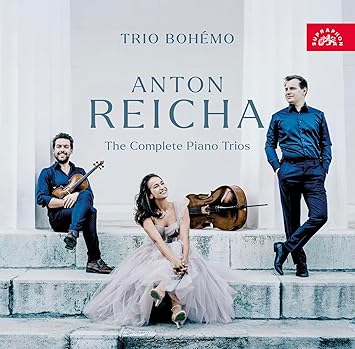
Anton Reicha
The Complete Piano Trios (2 discs)
Trio Bohémo
Supraphon (dist. Naxos)
SU-4363-2
Anton Reicha was a contemporary of Beethoven and reportedly both a friend and musical competitor. Beethoven would, of course, go on to eclipse Reicha entirely, to the point that the latter’s music has only recently begun to be regularly performed and recorded. As this outstanding set demonstrates, that’s lucky for us but very sad for listeners of the late19th and 20th centuries, who missed out on some of the most sparklingly lovely music of the late classical period. Reicha was a composition instructor to figures no less towering than Hector Berlioz, César Franck, and Charles Gounod, and Berlioz himself bemoaned the fact that so much of Reicha’s music remained unpublished in 1836, several years after Reicha had mostly stopped composing. Playing on modern instruments, the Trio Bohémo are powerful exponents for these masterful works, and this may be the first complete recording of them. (The Guarneris and the Kubeliks have each recorded selections, on discs that are now out of print.) Any library that supports a classical music curriculum would do well to snap this one up.
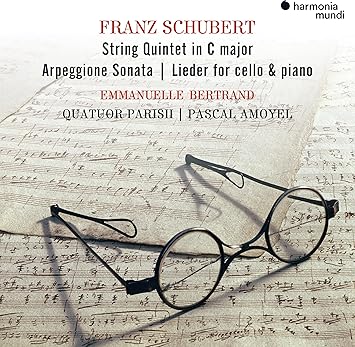
Franz Schubert
String Quintet in C Major; Arpeggione Sonata; Lieder for Cello & Piano
Emmanuelle Bertrand; Pascal Amoyel; Quatuor Parish
Harmonia Mundi (dist. Integral)
HMM 902766.67
Everyone is familiar with Schubert’s “Arpeggione” sonata, but not everyone knows that it was originally written for an instrument that had only a brief life before falling into disuse and extinction: the guitare d’amour, a large, six-string, fretted guitar that was designed to be bowed rather than plucked. In retrospect, it’s easy to see why it fell so quickly out of favor — however, the instrument interested Schubert enough that he wrote a sonata for it (calling it an arpeggione rather than a guitare d’amour) that has become one of the most beloved pieces in his chamber repertoire. An arrangement of that charming work for cello and piano is the centerpiece of this emotionally complex program, which also includes much darker fare: cello/piano arrangements of several of Schubert’s more intense lieder, and the emotionally fraught C major string quintet, as well as his famously yearning “Ave Maria” setting. The lieder transcriptions (with the exception of Ritsuko Nazé’s setting of Litanei auf das Fest aller Seelen) were created by Bertrand and Amoyel for this recording, and are excellent. Highly recommended.
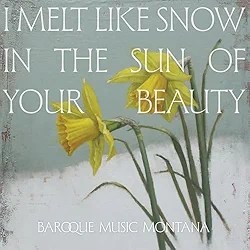
Various Composers
I Melt Like Snow in the Sun of Your Beauty
Baroque Music Montana
Black Bear
BMM 02
The music of the early baroque period is particularly interesting — it’s always fun to hear the remnants of Renaissance rhythmic syncopations and emotional gestures starting to settle into the more structurally rigorous baroque forms. For their latest album, Baroque Music Montana is operating with a rather unique configuration: violin, dulcian (i.e. baroque bassoon), theorbed lute, and soprano voice. The program focuses on Italian composers both familiar (Monteverdi, Palestrina) and less so (Tarquinio Merula, Biagio Marini), but opens with works by the acclaimed early German baroque composers Johann Schein (represented by the sacred song “Herr, wenn ich nur dich habe”) and Johann Rosenmüller. Trio sonatas, fantasias and capriccios rub shoulders with dramatic vocal pieces, and while all of the playing is outstanding, the singing by soprano Arwen Myers is particularly noteworthy. It’s also worth pointing out that while the largest and most influential early-music scenes continue to exist mainly on the coasts of the US, this recording clearly demonstrates what a high level of early-music-making is happening in the heartland.
JAZZ
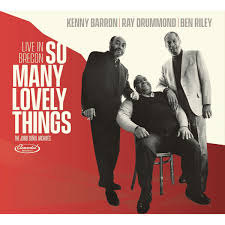
Kenny Barron; Ray Drummond; Ben Riley
So Many Lovely Things: Live in Brecon (2 discs)
Elemental Music
5990464
One of life’s great musical joys is listening to Kenny Barron play piano. And when he’s doing it in the company of bassist Ray Drummond and drummer Ben Riley, well, the pleasure is just compounded. This remarkable two-disc set is yet another product of producer/archivist Zev Feldman’s ongoing efforts to find buried jazz treasures and bring them to light. In this case, it involved working with veteran Spanish jazz promoter Jordi Suñol, who had tapes from a 1995 jazz festival appearance by this trio in his archives and agreed to let them be released. After loving sound restoration by Marc Doutrepont they now represent a studio-quality musical document of an utterly delightful performance. Barron’s solo rendition of Thelonious Monk’s “Shuffle Boil” is a welcome reminder of the degree to which stride piano was ever-present in Monk’s work, and the trio’s renditions of familiar standards like “The Very Thought of You” and “Surrey with the Fringe on Top” reveal a group at the peak of its powers. No library with a collecting interest in jazz can afford to pass this one up.
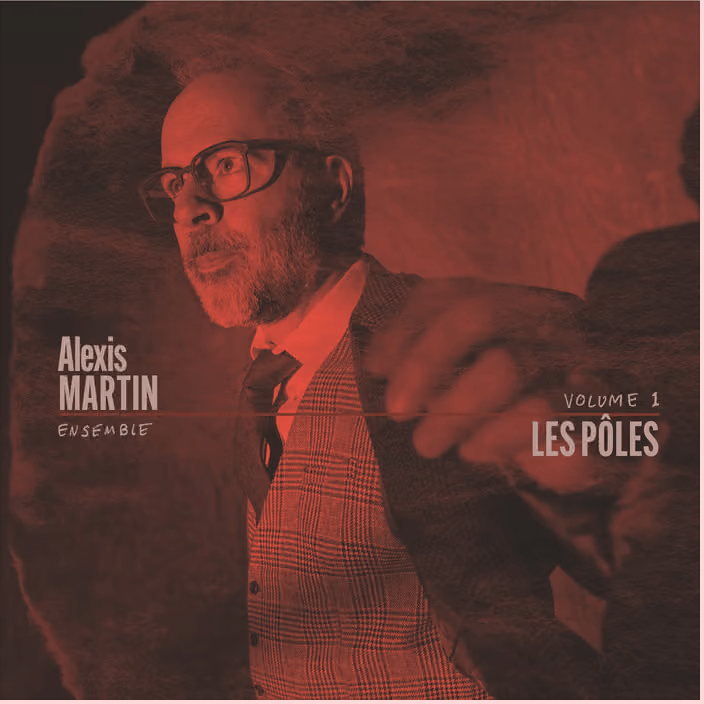
Alexis Martin Ensemble
Les pôles Volume 1
Self-released
No cat. no.
Listening to Alexis Martin’s debut album as a leader, you won’t be surprised to learn that he’s had a career in composition for film and television: his scoring is expansive, even when he’s writing for relatively few instruments, and structurally his pieces bear little obvious relationship to the standard head-solos-head format of most jazz performance. But you might be surprised to learn that he’s a drummer. Not only are there no drum solos, there is relatively little of what anyone might consider either swinging or a groove. Instead, what we have are seven musical vignettes that are (in the words of the press release) “inspired by life’s many moments of transition: the constant transformation of the world, memories sparked by certain places, the endless wonder of childhood, and the search for comfort and solace.” I think that description is very apt. The music blooms and floats and sings, and the line between composed and improvised passages is often hard to discern. I can’t wait for Volume 2.
Kalia Vandever
Another View
Northern Spy
NS 176
I’ll confess that what initially put this album at the top of my “definitely listen” pile wasn’t the name of the leader — with whom I wasn’t yet familiar — but rather seeing Mary Halvorson’s name on the credits. Halvorson is, in my opinion, the most exciting guitarist in forward-thinking jazz right now, and I’ll listen to anything she does. In this case, she drew me in to listen to the work of Vandever, who I now believe to be one of the finest trombonists in jazz at the moment. Her tone is what struck me first: on the album-opening “Staring at a Cracked Window” she has a warm, intimate, burnished sound that just knocked me out, and her use of vibrato is especially impressive. In her compositions she utilizes minimalist repetition (“Withholding”), arrhythmic impressionism (“Cycle in Mourning”), and gradual groove-building (“Unearth What You Already Knew”) to brilliant effect. And Halvorson’s solos, with their typical blend of clean, straight-ahead tone and oddball pedal effects, particularly octave displacement, are always a highlight.
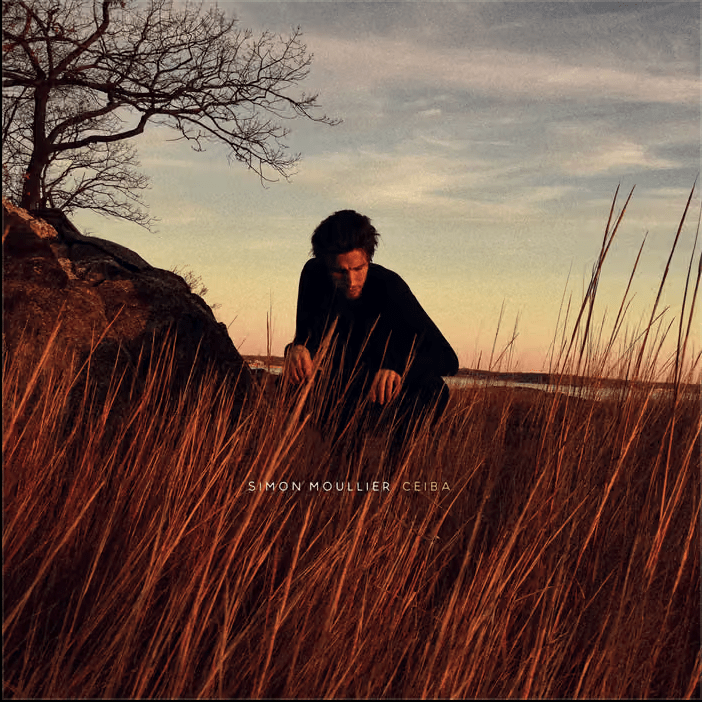
Simon Moullier
Ceiba
Self-released
No cat. no.
I’ve championed the work of vibraphonist/composer Simon Moullier in these pages before, and am excited to have the opportunity to do so again with this, his latest album as a leader. On Ceiba, an all-original program, he brings a really unique melodic language to bear. The music swings (except when it slinks and struts, as on “Iron Giant”), but melodically and harmonically it moves in unusual ways: consider, for example, the technically blues-based but boppishly complex “Low Blues,” or the quiet and contemplative “Voices of the Wind.” On the other hand, when paying tribute to his hero Bobby Hutcherson, he slides into a fast and powerful groove, the head melody sliding along at half tempo while the drums swing almost frantically on top. Percussionist Keito Ogawa augments the quartet on a couple of tracks, both of which are highlights. Recommended to all jazz collections.
Darren Litzie
On My Own Time
Summit (dist. MVD)
DCD 847
Pianist/composer Darren Litzie’s particular genius lies in his ability to write straight-ahead jazz compositions that combine complexity with immediate accessibility. Take, for example, the baião composition that opens his new album: it’s built on a sweet and relatively simple melodic idea with a distinctly gospel flavor — but the rhythmic pattern is intense and complex, and on his solo he goes off on modal excursions that reward close listening. “Busy Work” borders on funk, while Litzie’s arrangement of Thelonious Monk’s “In Walked Bud” practically deconstructs it in a thrilling way. But my favorite track is “A Short Walk from Here,” a beautifully composed number that puts dotted rhythms over swing triplets in a way that somehow manages to create tension while also conveying total relaxation. I’ll be watching for much more from this prodigiously talented artist in the future.
FOLK/COUNTRY
Mélisande
Sur la même longueur d’onde (digital only)
Quartier Général
No cat. no.
If this doesn’t sound like Québecois folk music to you, listen more closely: the rhythms on lead track “Francos d’Amérique” are clearly derived from the foot percussion that underlies traditional fiddle playing in the region, and that’s an Irish flute on the bridge. Sure, there’s also a thudding four-on-the-floor disco drum part, and a French rap interlude, and electronic pitch correction on the vocals. But folk tradition always evolves; people thought it was sacrilegious when La Bottine Souriante added a horn section, too. So if you’re a purist, look elsewhere — but if you’re looking for a good time, Mélisande is here to offer it. From the pure electropop joy of “À l’abri du tempo” to the blissfully chugging, subtly dubwise “Dans tour les états,” she’s calling you to the dance floor and doesn’t seem willing to take “non” for an answer. Sure wish this album were more than 25 minutes long.
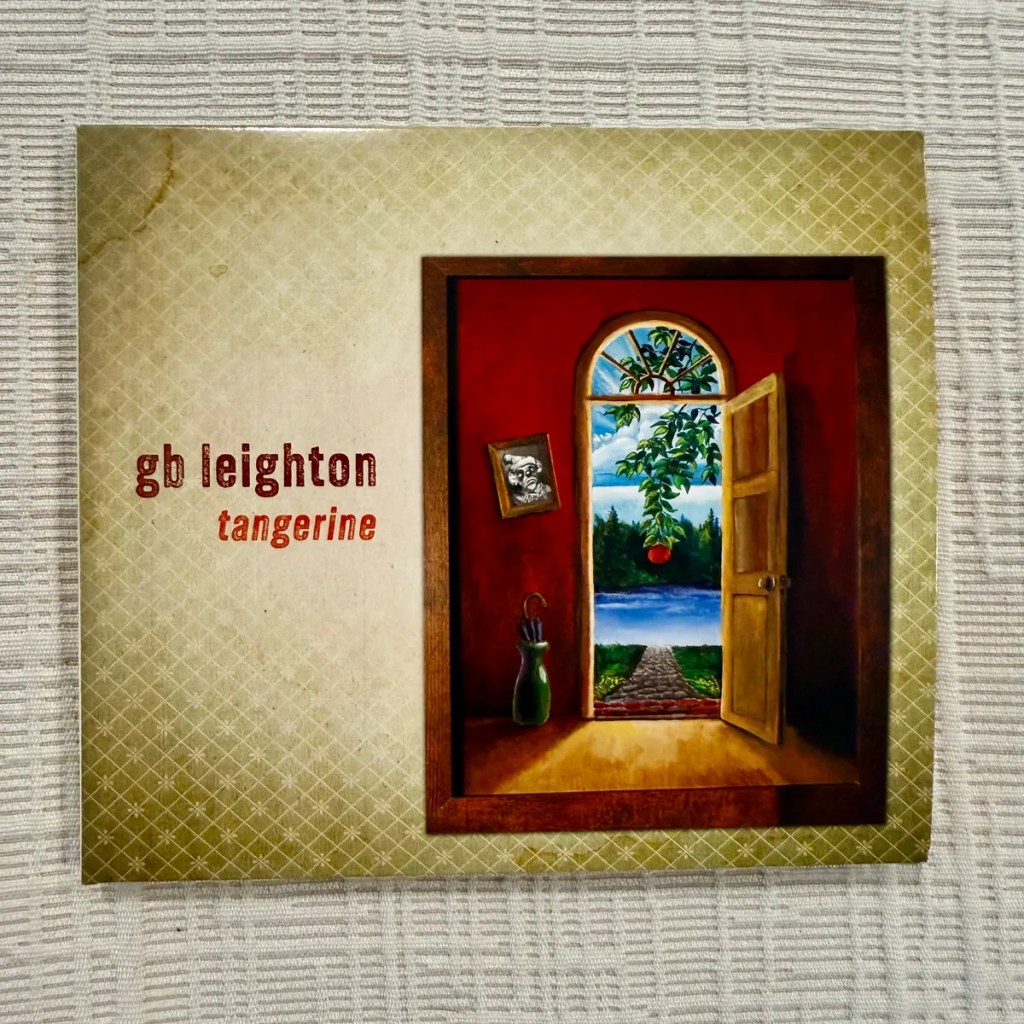
gb leighton
Tangerine
Moonsong
PR-2606-CD
Minnesota-based singer-songwriter Brian Leighton fronts a band called gb leighton, which has a rabid regional following in the Midwest and has been called one of the Top 10 Country Artists to Watch by Billboard Magazine. Leighton has been on the scene for 30 years now, and if he’s struggling to break out nationally, it may be because his vision of country is somewhat at loggerheads with a music industry that seems mainly able to understand “country” as either R&B with an exaggerated southern accent or trucker-hat jingoism. To be fair, thought, there’s a good chance that Leighton wouldn’t really characterize his music as “country” either, though that Telecaster solo on “Never Have to Worry about Me Again” wouldn’t sound out of place on a Brad Paisley album, and someone is definitely playing banjo on “The One You Found.” (On the other hand, “We Could Run” sounds like a particularly good Bruce Springsteen song.) Of course, what really matter are the hooks, and they’re everywhere. And Leighton sings better than Springsteen.

Danny Paisley & The Southern Grass
Bluegrass State of Mind
Pinecastle Recording Company (dist. MVD)
PRC1280
This album represents something of the continuation of a legacy. Danny Paisley’s father Bob was a legend of the traditional bluegrass scene in the Midatlantic who played for years alongside the equally legendary banjo player Ted Lundy in the Southern Mountain Boys. Now Danny continues the tradition with a band that also features two of Lundy’s sons, T.J. (on fiddle) and Bobby (bass). Their style is 100% authentic, straight-ahead, old-school bluegrass: no electric bass, no drums, no Bob Dylan covers. Instead, you get twin fiddles, meat-and-potatoes Scruggs-style banjo (with maybe an occasional sly Trischka lick), and songs with titles like “Have I Stayed Away Too Long” and “Two Old Church Pews.” You also get Danny Paisley’s voice, which is an absolute marvel of high-lonesome clarity and power. You can hear echoes of George Jones in the way he clenches his throat at the end of a phrase, and of Joe Val in the strength of his high end, but his style is ultimately his own. Strongly recommended to all libraries.
ROCK/POP
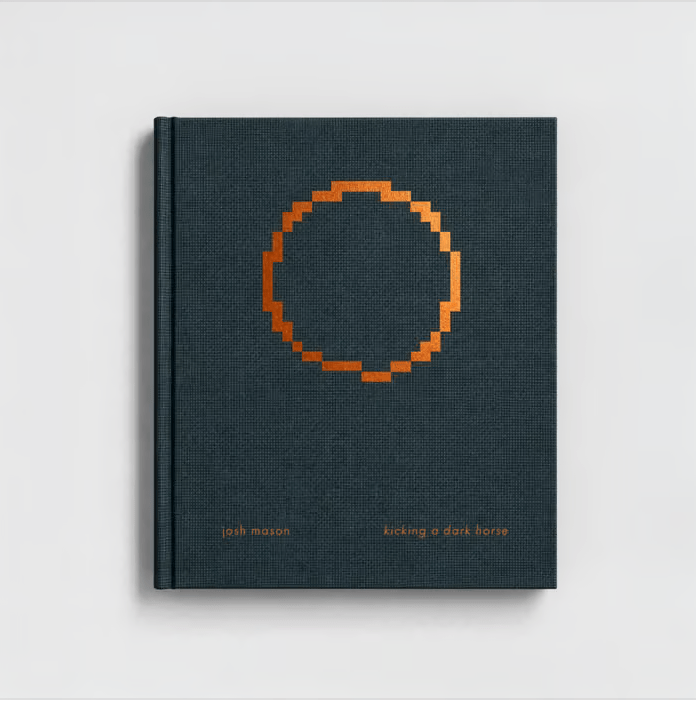
Josh Mason
Kicking a Dark Horse (book & digital only)
Greyfade
No cat. no.
I confess that when it comes to music releases, I tend to be a little impatient with innovative packaging design. It’s not that I don’t appreciate the artistry and creativity that often go into them; it’s just that I’m more interested in the music than the design, and innovative packaging is often hard to manage. (This is also an obvious problem for library shelving.) But as I’ve gotten to know the Greyfade label over the past few months, I’ve found myself softening a bit. This new release of experimental ambient music by Josh Mason is a good example of the kind of album that is bringing me around. It’s actually a hardcover book containing text that appears (from the photos I’ve seen) to be a cross between poetry, cut-up, and prose; the book comes with a download code for an album of Mason’s music, which is glitchy and eerie and quiet and unsettling — a bit like a cross between Brian Eno’s Discreet Music and some of Jon Hassell’s “Fourth World” compositions, and an example of what I believe is best and most interesting in ambient music. Literally anyone can produce harmonically static pleasantries or pentatonic wind-chime compositions; very few can make quiet music that both resists structural analysis and rewards close listening. Mason does that admirably on this album.

Rapoon
The Silent Trumpets
Klanggalerie (dist. MVD)
gg536
While we’re on the topic of challenging ambient music, let’s look in on Robin Storey, shall we? Just to review: he started recording under the name Rapoon after leaving Zoviet France in 1992; while Zoviet France continued to produce more abrasive, industrial-adjacent material, Storey has opted to explore more introspective modes of expression — which is not to say that his music is either simple or straightforward. You never know for certain exactly what you’ll get with a new Rapoon release; it could be piano compositions, or an acoustic ensemble, or ambient electronica with Middle Eastern or South Asian inflections. This time it’s an interesting program of simple programmed drums, spoken word (by whom is unclear; the CD offers no information beyond track titles), and sparse synth parts. There are moments when things get darker: for example, the strangely foreboding “I Love You” and the Muslimgauze-invoking “Mishi Mishi.” “Escape to Light” uses synthesized tabla and sitar to create a minimalist sound tableau, while “Stars Over the Bosphorus” blends what sounds like a Casiotone drum machine with dry percussion and heavily reverbed synths. It won’t be everyone’s cup of tea, but Storey continues to produce some of the most conceptually interesting instrumental music around.
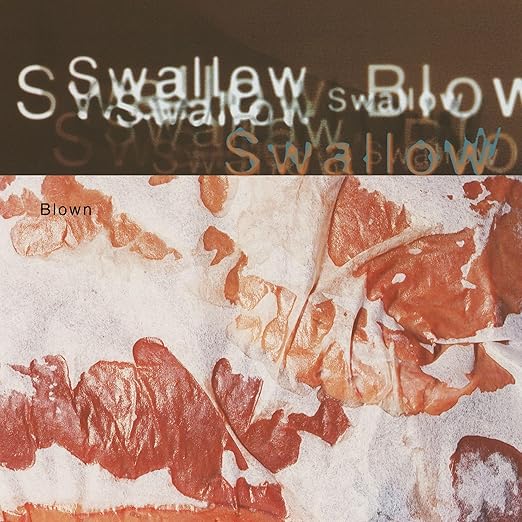
Swallow
Blown (2 discs; expanded reissue)
4AD (dist. Redeye)
4AD-0866-CD
You may not remember Swallow. They emerged in the early 1990s, the heyday of the wonderful 4AD label, which by that point had already brought us world-changing releases from the likes of Cocteau Twins, This Mortal Coil, Pixies, and Throwing Muses. At the time, 4AD was one of those labels that had its own distinct sound: while there was significant stylistic diversity among its roster, you could count on atmospheric production a certain arch artiness that appealed equally to Goths and recovering punk rockers. Swallow made one album, Blow, and it was vintage 4AD: the instrumental opening track comes roaring in with pounding drums, shimmering overdubbed guitars, and a solo guitar part that could have been lifted from a Big Country album. When Louise Trehy starts singing, her voice is light but powerful and delivers lilting melodies that contrast beautifully with what are sometimes nearly punkish settings — “Sugar Your Mind,” in particular, could have been a collaboration between the Cocteaus and the Sundays. Selections from Blow were later remixed by a variety of artists and released under the title Blowback; this two-disc set brings together the contents of both albums along with a couple of 12″ singles. Recommended to all pop collections.
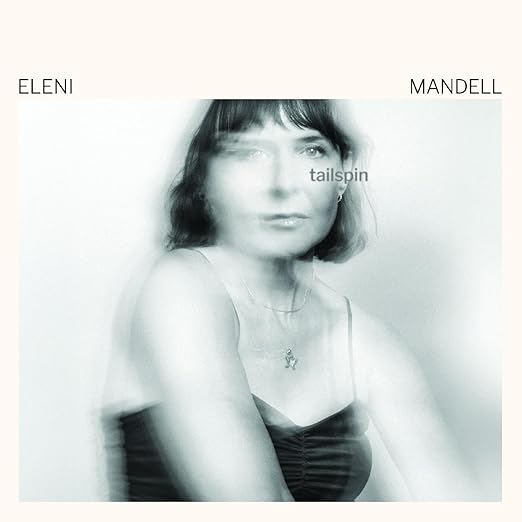
Eleni Mandell
Tailspin
Schoolkids (dist. Redeye)
CD-SMR-094
Press releases for new albums often include a “For Fans of” list to help reviewers and buyers get a sense of what to expect from the artist. The “For Fans of” list attached to the one-sheet for Eleni Mandell’s latest album includes Mitski, Big Thief, and Tom Waits. Which… yeah, okay, I can see it. But of those three, I think the most instructive comparison is to Tom Waits. On the one hand, they couldn’t be more different — Waits is notorious for his ridiculously abrasive voice and his atavistic Skid Row persona (which he leavens with winking self-awareness). But what’s easy to miss is how brilliantly he writes melodies, and that’s the most important thing he and Mandell have in common. They also share a penchant for the musically anachronistic; he harks back to music halls and Tin Pan Alley, whereas Mandell looks back to Laurel Canyon and 1960s pop. And her voice is a pure joy to listen to. Anyone who can listen to the opening bars of “Lemon Tree” without being moved needs to have his pulse checked; it’s the most brilliant start to a pop song since her “The Future” (“I want to fall in love again, I know where it will happen/Along the California coast, where the ocean meets the mountains”). Strongly recommended to all libraries.

Teddy Thompson
Never Be the Same
Royal Potato Family
No cat. no.
I was really interested to see where the great singer-songwriter Teddy Thompson’s head would be on his new album. Lyrically, I knew what to expect: soft, sharp, insightful songs about trying to give and receive love delivered in a voice that I’ve always found to be a mystery: how can it be so simple and plainspoken and yet so powerfully affecting? But musically, the question was whether this was going to be another country album. And the answer is no: with Never Be the Same he’s back in pop mode, with the occasional Twin Peaks guitar tremolo or barrelhouse piano part sneaking in slyly around the edges. There are other influences here too, of course: “So This Is Heartache” is a 12/8 soul number that Sam Cooke would have killed to sing; “Make Up Your Mind” is built on what can only be called a polka beat, a stomping rocker over which Thompson sings with stoic, brokenhearted clarity (and yes, that’s his dad Richard on guitar). All of it is as satisfying as a well-balanced meal.
WORLD/ETHNIC
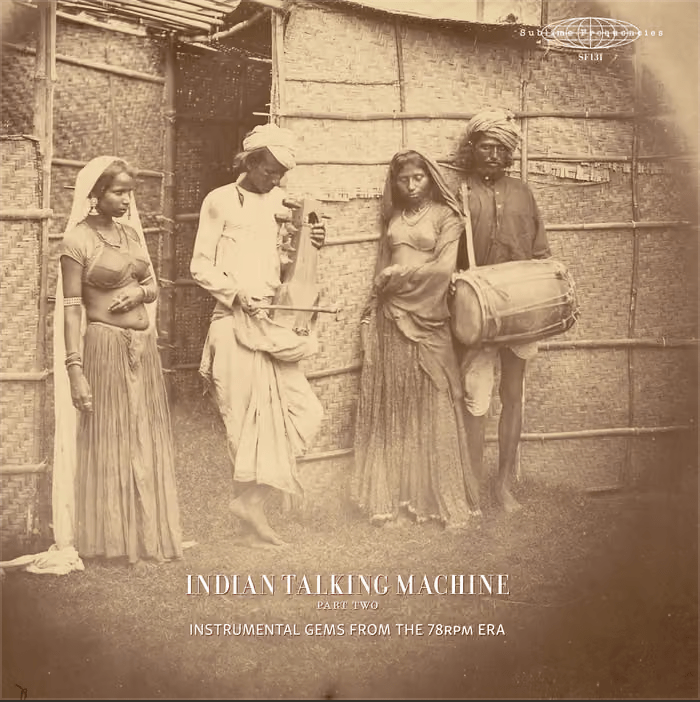
Various Artists
Indian Talking Machine Part Two: Instrumental Gems from the 78rpm Era (2 discs; vinyl & digital only)
Sublime Frequencies (dist. Forced Exposure)
SF 131
If your library collection could use (or you just want for yourself) an overview of classical and folk music from India played on a variety of instruments — from the familiar (sitar, violin, tabla) to the less-so (shenai, sundri, kashta-tarang) — consider this amazing compilation of 78-rpm recordings made on the Subcontinent between 1904(!) and 1958. It’s amazing partly because the music is wonderful: 26 brief tracks by a huge variety of musicians. But also partly because the sound quality is so surprisingly good; even the sitar and vina recordings from 1904 and 1910 are listenable, and the later ones are downright pleasant. This collection follows a first volume under the same title (still available, but only digitally) and together they form both a useful and an enjoyable introduction to the music of India. Sadly, the package includes no track annotations, making the album a bit less useful for pedagogical purposes.
Various Artists
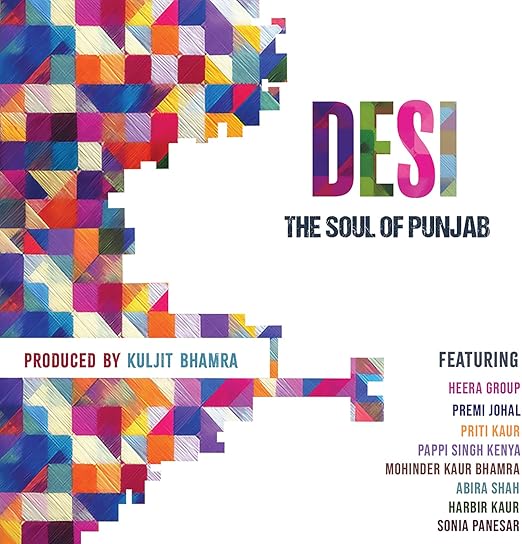
Desi: The Soul of Punjab
ARC Music (dist. Naxos)
EUCD2989
I cued this one up kind of expecting to hear electro-infused Punjabi pop music, with maybe a hint of bhangra in the mix. What I got was something very different: Punjabi folk songs (some contemporary, some ancient) performed with mostly traditional instrumentation but with modern production and only subtle use of electronic keyboards and percussion. The songs are performed by a variety of artists, and are divided into three thematic categories: viyah (wedding), pyar (romantic), and ajoka (contemporary). Everything is very high-energy — these are songs designed to get people up and moving, with brisk tempos, energetic call-and-response vocals, and layered percussion and sometimes horns. Highlight tracks include “Jind Mahiya” (which features the gorgeous singing of Priti Kaur), and the sultry “Ve Jogi Mundran Walia.” Highly recommended.

Mohinder Kaur Bhamra
Punjabi Disco (expanded reissue; 2 discs; vinyl & digital only)
Naya Beat
NAYA-009LP
Here’s a real treat: a long-out-of-print release from 1982 that represents the first dance music album ever recorded by a British South Asian singer. When she recorded Punjabi Disco, Mohinder Kaur Bhamra was already a legend in London’s Asian community, a highly sought-after singer for weddings and religious celebrations. Her son Kuljit convinced her to make a disco album, accompaning her on a Roland synthesizer while his 11-year-old younger brother played a CR-8000 CompuRhythm drum machine. The resulting sound is certainly — shall we say — of its time, but that’s part of the charm: listening to Bhamra’s sweet, clear, and incredibly nimble voice as it dances over the old-school synth textures, science-fiction percussion sounds, and West-meets-East harmonic arrangements is an absolute joy. This reissue includes some contemporary remixes and a recently discovered additional track. The Naya Beat label deserves a Nobel Prize for bringing this fantastic album back to market.

Hollie Cook
Shy Girl
Mr Bongo (dist. Redeye)
MRBCD323
Hollie Cook
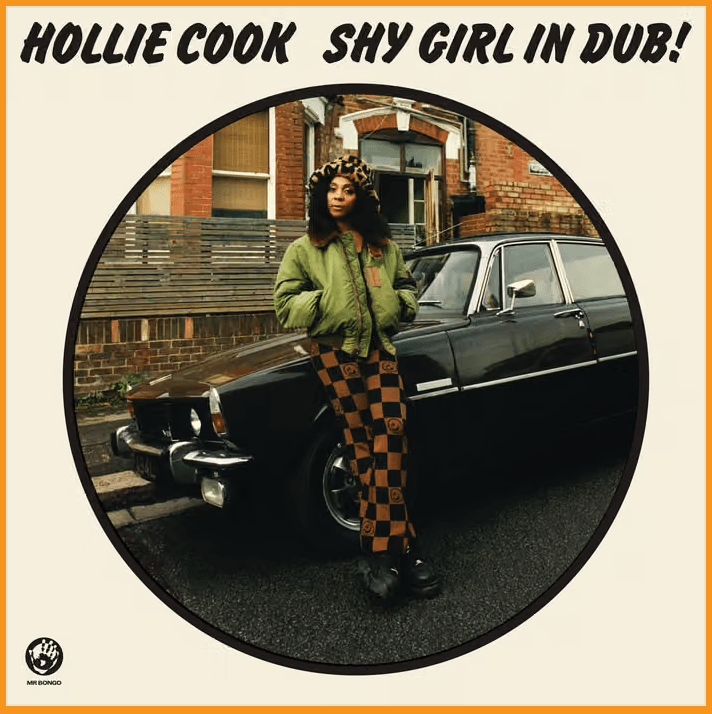
Shy Girl in Dub!
Mr Bongo
MRBCD341
Over the past 15 years, Hollie Cook has quietly but relentlessly become the leading exponent of old-school “lovers rock”-style reggae. This is a reggae subgenre characterized by cool, relaxed, but emotionally powerful love songs that are sometimes celebratory and sometimes regretful — historically, the greatest artists in this genre have been women (think Carroll Thompson, Kofi, Brown Sugar, Sandra Cross), and right now I don’t believe any other artist in this genre is operating at Cook’s level. Since she started releasing albums in 2011, she has moved from strength to strength. Last year she released Shy Girl, possibly her best album so far, which marks her return to the excellent Mr Bongo label. Her backing band here is the outstanding General Roots, who provide a smooth but solidly rootsy groove on bittersweet tracks like “Crying Wolf” and “Holding On,” creating a jewel box setting for her sweet voice and cool, dignified delivery. And now we have Shy Girl in Dub!, on which General Roots’ Ben McKone strips the original tracks down and rebuilds them with instrumental dropouts, creative echo and delay, and lots of space. The two albums together would make an outstanding addition to any library’s pop or reggae collection.


Lovely collection this month. The melisande album is pure joy. There’s lots of good music up here in the 51st state! 😉
Thanks, Michael! Glad you enjoyed.